

Last updated: October 1, 2026
Choosing between SNAP and NMAT is a bit like choosing between a sprint and a middle-distance race. Both are computer-based MBA entrance exams, offer three attempts, and open doors to well-regarded private B-schools. However, their exam patterns, difficulty levels, scoring systems, dates, fees, and college options differ significantly. This SNAP vs NMAT guide compares the 2026 exams across these factors to help you identify the test that better matches your strengths.
Timing matters this year. NMAT registration closes on October 10, 2026, while SNAP registration runs until November 25, 2026. SNAP also changed its paper in 2026 by adding a new Ethics, Morality and Values section. Some older comparisons still describe the three-section SNAP, so check the date on any source you use.
SNAP vs NMAT at a Glance
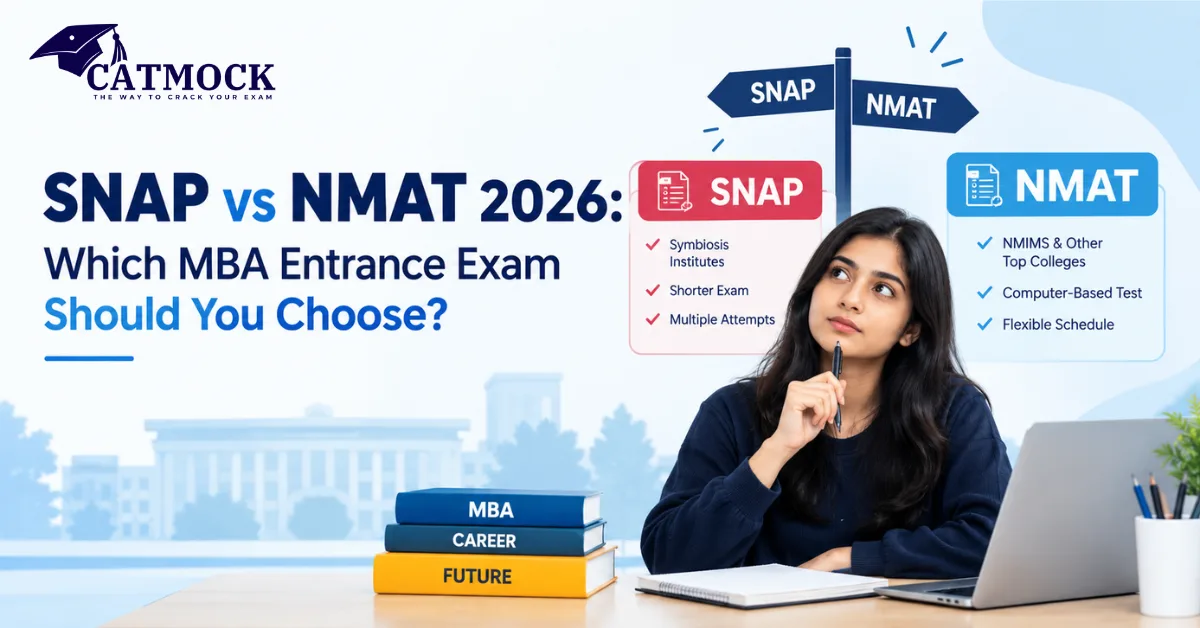
The short version: SNAP is a 60-minute, 60-question sprint with a 0.25 penalty for wrong answers, built around Symbiosis institutes. NMAT by GMAC is a 120-minute, 108-question test with sectional timers and no negative marking, accepted by NMIMS and several other private B-schools.
Table 1: SNAP vs NMAT 2026 key differences
| Parameter | SNAP 2026 | NMAT by GMAC 2026 |
|---|---|---|
| Conducting body | Symbiosis International (Deemed University) | Graduate Management Admission Council (GMAC) |
| Total questions | 60 | 108 |
| Duration | 60 minutes | 120 minutes |
| Sections | 4 | 3 |
| Negative marking | −0.25 per wrong answer | None |
| Sectional time limit | No | Yes |
| Attempts | Up to 3 tests, best score considered | Up to 3 attempts (including no-shows) |
| Registration window | Aug 21 – Nov 25, 2026 | Aug 20 – Oct 10, 2026 |
| Exam dates | Dec 13, 19 and 26, 2026 | Nov 2 – Dec 20, 2026 |
| Fee | ₹2,550 per test + ₹1,000 per programme (plus taxes) | ₹3,000 (plus taxes) |
What Is SNAP?
Who conducts SNAP and who accepts it
The Symbiosis National Aptitude Test (SNAP) is the entrance test for MBA programmes at 17 Symbiosis institutes. These include SIBM Pune, SCMHRD and SIIB. You register once on the official SNAP website, choose your institutes, and pay ₹1,000 for each programme you want to be considered for.
The 2026 change: Ethics, Morality and Values
The biggest update is a fourth section on Ethics, Morality and Values. The paper stays at 60 questions in 60 minutes, so something had to give. General English dropped from 15 to 10 questions, and Analytical & Logical Reasoning dropped from 25 to 20. Quantitative, Data Interpretation & Data Sufficiency stays at 20. For a deeper walkthrough, read our SNAP 2026 new pattern guide.
What Is NMAT by GMAC?
Who conducts NMAT and who accepts it
NMAT is a computer-based MBA entrance exam conducted by GMAC, the body behind the GMAT. Its scores are accepted by NMIMS and a group of other business schools, including XIMB and TAPMI. Registration and slot booking happen on the official NMAT by GMAC page.
Adaptive format and sectional timing
NMAT has three sections of 36 questions each: Language Skills, Quantitative Skills and Logical Reasoning. Each section has its own timer. When a section’s time ends, your answers are submitted automatically. You can choose the order in which you take the sections, which is a real advantage if one section worries you.
The exam is also described as adaptive, meaning question difficulty can respond to how you perform. In practice, accuracy on early questions matters, and you should avoid leaving questions unanswered at the end of a section.
SNAP vs NMAT Exam Pattern: Section by Section
The two patterns look similar on paper, since both test English, reasoning and quantitative ability. The differences are in the question counts, the clock and the extra Ethics section in SNAP.
Table 2: Section-wise pattern comparison
| Exam | Section | Questions | Time |
|---|---|---|---|
| SNAP | General English | 10 | Single 60-minute clock |
| SNAP | Analytical & Logical Reasoning | 20 | Single 60-minute clock |
| SNAP | Quantitative, DI & Data Sufficiency | 20 | Single 60-minute clock |
| SNAP | Ethics, Morality & Values | 10 | Single 60-minute clock |
| NMAT | Language Skills | 36 | 28 minutes |
| NMAT | Quantitative Skills | 36 | 52 minutes |
| NMAT | Logical Reasoning | 36 | 40 minutes |
The takeaways are simple. SNAP lets you move freely across sections and spend time where you score fastest. NMAT locks you into a section clock but gives you control over the order. SNAP’s reasoning and quant sections together make up two-thirds of the paper. NMAT gives each skill equal weight.
SNAP vs NMAT Difficulty Level
Most sources rate both exams as moderate, and both are easier than CAT. The challenge comes from different places.
Why SNAP feels hard
SNAP gives you an average of about one minute per question. That is fine for direct questions but tight for puzzles and data sets. Add the 0.25 penalty and every guess carries a cost. Candidates who read quickly and decide fast tend to do well.
Why NMAT feels hard
NMAT gives you more total time, but the sectional timer is strict. Language Skills averages under 50 seconds per question, which punishes slow readers. The adaptive element also means a few early mistakes can change the difficulty you see next. Candidates who like a structured, penalty-free format tend to do well.
Table 3: Time pressure and risk profile
| Factor | SNAP | NMAT |
|---|---|---|
| Average time per question | About 60 seconds | About 67 seconds overall |
| Tightest section | Quant and DI (shared clock) | Language Skills (about 47 seconds per question) |
| Most generous section | Your choice (shared clock) | Quantitative Skills (about 87 seconds per question) |
| Wrong-answer penalty | Yes (−0.25) | No |
| Risk level of guessing | Higher | Lower |
Negative Marking, Attempts and Scoring
Negative marking
SNAP awards +1 for each correct answer and deducts 0.25 for each wrong one. Unattempted questions carry no deduction. NMAT has no negative marking, but unanswered questions at the end of a section can still hurt your score. Attempt everything before the timer ends.
Attempts
Both exams allow up to three attempts, and the best score is considered. For SNAP, the three attempts are the three test dates in December. For NMAT, the three attempts include no-shows, so don’t book a slot you can’t keep.
Scoring
SNAP is scored out of 60 and converted to a percentile. NMAT reports a score of 12 to 120 for each section and a total between 36 and 360. NMAT scorecards are usually available within 48 hours of the test, while SNAP results are expected in January 2027.
Dates, Registration and Fees for 2026
- NMAT registration: August 20 to October 10, 2026. Slot booking closes October 22.
- NMAT exam window: November 2 to December 20, 2026.
- SNAP registration: August 21 to November 25, 2026.
- SNAP test dates: December 13, 19 and 26, 2026.
- Budget: NMAT costs ₹3,000 plus taxes. SNAP costs ₹2,550 per test plus ₹1,000 per programme, plus taxes.
Book NMAT slots early, because they are allotted first-come, first-served. Once you pay the SNAP fee, you can’t change the test date or city.
Colleges Accepting SNAP vs NMAT
Your target college should drive your exam choice more than any difficulty ranking. SNAP is essentially the gateway to Symbiosis. NMAT serves NMIMS and a wider set of independent schools.
Table 4: Where each score is used
| Aspect | SNAP | NMAT |
|---|---|---|
| Main accepting institutes | SIBM Pune, SCMHRD, SIIB and other Symbiosis institutes | NMIMS, XIMB, TAPMI and other private B-schools |
| Number of institutes | 17 Symbiosis institutes | A broader mix of independent schools |
| Application process | Pay a fee for each programme | Share your score with chosen schools |
| Best fit | Candidates set on Symbiosis | Candidates set on NMIMS or similar schools |
Cut-offs change every year and depend on the programme, so check each institute’s official criteria before finalising your plan.
Which Exam Should You Choose?
Choose SNAP if…
- Symbiosis institutes are your top targets.
- You think and read quickly, and you’re comfortable skipping hard questions.
- You can handle a 60-minute, high-pressure paper.
- You enjoy reasoning and puzzle-style questions.
Choose NMAT if…
- NMIMS or other NMAT-accepting schools are your priority.
- You want no negative marking and the freedom to choose section order.
- You prefer a longer paper with a clear structure.
- Your weakest section needs extra time, and you’d rather start with your strongest.
Should you take both?
Often, yes. The syllabus overlaps heavily, so preparing for one covers most of the other. Taking both widens your college options and gives you more attempts. The main extras are Ethics for SNAP and sectional-timer practice for NMAT. If budget allows, a combined plan is usually the safest route.
How to Prepare for SNAP and NMAT Together
NMAT’s window opens on November 2, about a month from today, and SNAP’s first test is on December 13. A staggered plan works well.
- Weeks 1–2: Revise core English, reasoning and quant fundamentals.
- Weeks 3–4: Take timed sectional practice. For NMAT, practise with the exact section clocks using NMAT mock tests.
- Weeks 5–6: Attempt full-length NMAT mocks, then analyse errors.
- Weeks 7–9: Shift to SNAP mock tests. Practise 60 questions in 60 minutes and train yourself on when to skip.
- Ethics prep: Read about business ethics, moral dilemmas and current ethical debates.
If you’re also considering CAT, our CAT mock tests help you test your level across all three exams. For a fuller breakdown of the NMAT format, see our NMAT exam pattern guide.
Summary
- SNAP is a 60-question, 60-minute exam with four sections and −0.25 negative marking.
- NMAT is a 108-question, 120-minute exam with three sectional-timed sections and no negative marking.
- Both are rated moderate in difficulty, but SNAP is a speed test and NMAT is a time-management test.
- Both allow three attempts, with the best score considered.
- NMAT registration closes October 10, and SNAP registration closes November 25, 2026.
- SNAP is the route to Symbiosis. NMAT is the route to NMIMS and other private B-schools.
- Because the syllabus overlaps, preparing for both is practical.
Frequently Asked Questions
Which is easier, SNAP or NMAT?
Neither is universally easier. Both are generally rated moderate. NMAT removes the wrong-answer penalty and lets you choose section order, which lowers risk. SNAP demands quicker decisions, about one minute per question, with a 0.25 penalty. Fast, confident test-takers often prefer SNAP, while those who like structure prefer NMAT.
Does SNAP have negative marking in 2026?
Yes. SNAP gives +1 for each correct answer and deducts 0.25 for each wrong one. Unattempted questions carry no deduction.
Does NMAT have negative marking?
No. However, unanswered questions at the end of a section can reduce your score, so attempt every question before the sectional timer ends.
How many sections and questions are in SNAP 2026?
SNAP 2026 has 60 questions in 60 minutes across four sections: General English (10), Analytical & Logical Reasoning (20), Quantitative, DI & Data Sufficiency (20), and Ethics, Morality & Values (10).
How many attempts are allowed in SNAP and NMAT?
SNAP allows up to three tests, on December 13, 19 and 26, 2026, with the best score considered. NMAT allows up to three attempts, including no-shows, with the best score considered.
Can I take both SNAP and NMAT?
Yes. The syllabus overlaps, so one preparation plan covers most of both. Register for NMAT by October 10 and SNAP by November 25. Budget ₹3,000 plus taxes for NMAT, and ₹2,550 per SNAP test plus ₹1,000 per programme.
Which exam gives access to better colleges?
That depends on the institute, not the exam. SNAP leads to Symbiosis institutes such as SIBM Pune, while NMAT leads to NMIMS and other private B-schools. Compare the specific programmes you want, including their cut-offs and placement reports.
Conclusion
The SNAP vs NMAT decision comes down to three questions. Which colleges do you want? How do you handle time pressure? And can you do both? If Symbiosis is your goal and you thrive under speed, SNAP is the natural choice. If you want a penalty-free exam with sectional control and you’re aiming for NMIMS, NMAT is a safer fit. For most aspirants, preparing for both is the smartest move. Start with your target college list, pick your registration deadlines, and test your readiness with timed mocks. Take a free mock test on CATMOCK to see where you stand today.
You May Also Like : CAT MOCK, CAT MOCK PYQ
Follow Us On : Facebook, Instagram, Youtube