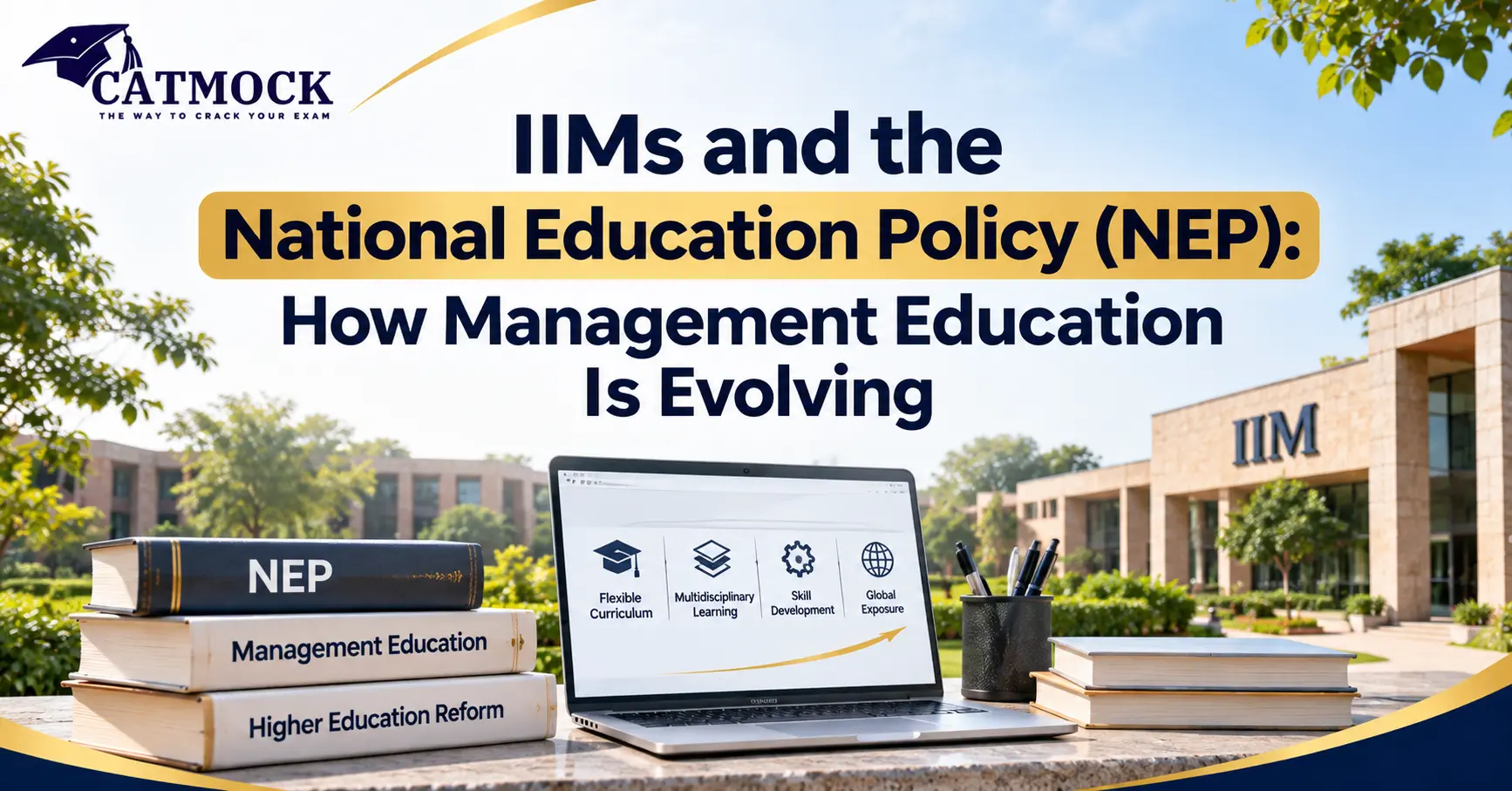
For decades, the Indian Institutes of Management stood for one thing in the public mind: a two-year MBA, a tough entrance exam and a campus placement season. That picture is changing. Since the National Education Policy (NEP) 2020 set out a new direction for Indian higher education, IIMs have been launching four-year undergraduate degrees, adding technology and data courses to the MBA, rethinking how and where they teach, and weaving Indian thought into management classrooms.
This guide explains how IIMs and the National Education Policy fit together, what has changed so far, what it means for different kinds of aspirants, and what to verify before you apply.
Quick answer: NEP 2020 pushes for multidisciplinary, flexible and skills-focused higher education. IIMs are responding with new undergraduate degrees, interdisciplinary MBA content, hybrid and executive formats, and expansion beyond their traditional residential campuses.
What Is the National Education Policy (NEP) 2020?
NEP 2020 is India’s national framework for education from school to university. It replaced the 1986 policy and was approved by the Union Cabinet in July 2020. For higher education, its main ideas are:
- Multidisciplinary learning. Students should combine subjects across sciences, humanities, technology and professional fields instead of being locked into one stream.
- Flexibility. Multiple entry and exit points, credit transfer and choice in courses.
- Four-year undergraduate degrees. A longer, broader bachelor’s with options to exit with a certificate, diploma or degree at defined stages.
- Skills and employability. Closer links between classroom learning, industry and experiential projects.
- Autonomy and quality. More freedom for institutions to design programmes and innovate.
- Indian knowledge and ethics. Greater attention to Indian knowledge systems, values and local context.
You can read the full policy on the Ministry of Education website.
Why NEP Matters for Management Education
Management education sits at the meeting point of business, technology, economics and society. A policy that rewards interdisciplinary thinking, flexible pathways and employability naturally affects how a business school designs its programmes. For IIMs, which are institutions of national importance, NEP is also a signal about where public higher education is heading.
How IIMs Are Responding to NEP: The Big Shifts
1. From Postgraduate Only to Undergraduate Entry
The biggest visible change is that several IIMs now offer undergraduate programmes. Earlier, the main route for school leavers was the five-year Integrated Programme in Management (IPM). Now there is also a wave of four-year degrees, including BSc and BMS programmes in areas such as economics, data science, digital business and public policy.
Examples reported publicly include:
- IIM Bangalore: four-year residential BSc (Hons) programmes in Economics and Data Science, delivered through its School of Multidisciplinary Studies at the Jigani campus.
- IIM Kozhikode: a four-year BMS programme at its Kochi campus, built around NEP guidelines.
- IIM Sirmaur: a four-year BMS with multiple exit options, plus a virtual-mode version.
- IIM Sambalpur: BS programmes in Data Science and AI and in Management and Public Policy.
- IIM Mumbai and IIM Ranchi: four-year undergraduate programmes in digital business and data science, and in AI and data science.
- IPM at multiple IIMs: five-year integrated programmes continue at institutes such as Indore, Rohtak, Jammu, Bodh Gaya, Ranchi, Shillong and Amritsar.
2. Multiple Exit Options and Credit Frameworks
Several IIM undergraduate programmes follow the NEP structure of a four-year, eight-semester course with a credit framework. The pattern commonly described is:
- Certificate after Year 1
- Diploma after Year 2
- Bachelor’s degree after Year 3
- Honours degree after Year 4
This gives students a safety net and flexibility that traditional three-year degrees did not offer.
3. A More Interdisciplinary MBA
NEP’s emphasis on integrating technical and professional subjects shows up in postgraduate curricula as well. IIMs have been adding analytics, machine learning, business intelligence, sustainability, public policy and design thinking, either as electives, specialisations or separate analytics-focused MBA programmes.
4. Indian Knowledge Systems and Ethics
NEP encourages engagement with Indian knowledge traditions. Some IIMs have introduced credit-based electives on Indian thought in management, Gandhian leadership, wellbeing and values-based decision-making. Academic research is also examining how IIMs can contribute to the Indian Knowledge Systems ecosystem. The aim is not to replace global frameworks but to add a local lens to them.
5. New Formats for Working Professionals
NEP highlights lifelong learning and upskilling. IIMs have built hybrid and online executive programmes, short certificates and part-time degrees so professionals can study without leaving their jobs. Synchronous digital delivery, learning management systems and virtual assessment have become standard tools.
6. Geographic Expansion
The traditional IIM model was a secluded, fully residential campus. That is changing. Institutes are opening urban learning centres in business hubs and exploring overseas presence to serve executives, new programmes and global ambitions.
NEP Principles vs. IIM Action: A Quick Map
Table 1: How NEP 2020 principles are showing up at IIMs
| NEP 2020 Principle | What It Means | How IIMs Are Responding |
|---|---|---|
| Multidisciplinary education | Combine business with technology, economics, humanities | New BSc/BMS degrees; analytics and policy courses; schools of multidisciplinary studies |
| Flexible entry and exit | Certificates, diplomas, degrees at stages | Four-year UG programmes with exit options |
| Skills and employability | Hands-on learning, industry links | Internships, live projects, immersion and experiential modules |
| Lifelong learning | Upskilling across career stages | Executive MBAs, certificates, hybrid and online programmes |
| Indian knowledge systems | Local wisdom and ethics in curriculum | Electives on Indian thought, leadership and wellbeing |
| Institutional autonomy | Freedom to design programmes | Newly launched UG degrees; new campuses and learning centres |
| Larger multidisciplinary institutions | Bigger, broader campuses | Expansion of student strength and new schools within IIMs |
IIM Undergraduate Programmes Under NEP: What to Know
If you are in Class 12 or just finishing school, this is the most relevant part of the story. IIMs now offer more than one way to start.
Table 2: Types of IIM undergraduate pathways (verify current details on official sites)
| Pathway | Typical Duration | Structure | Who It Suits |
|---|---|---|---|
| Integrated Programme in Management (IPM) | 5 years | BBA-level foundation followed by MBA, often with a 3-year exit | Students sure about a management career |
| BMS (Bachelor of Management Studies) | 4 years | Management-focused honours degree with NEP-style exits | Students who want a business degree at an IIM |
| BSc / BS in Economics, Data Science, AI | 4 years | Multidisciplinary degree combining analytics with business or economics | Students interested in data, economics or technology |
| Virtual or online UG options | 3-4 years | Digital delivery with immersion components | Students who need location flexibility |
Admission routes differ. Depending on the institute, they may involve IPMAT, JIPMAT, JEE-based scores, CUET or an institute-specific aptitude test, often followed by an interview. Eligibility, cut-offs and seats change from year to year, so read each institute’s current prospectus carefully.
Things to Weigh Before Choosing an IIM Undergraduate Degree
- Maturity of the programme. New degrees have limited placement history. Ask for details on how outcomes will be tracked.
- Campus and facilities. Some programmes run at newer or separate campuses. Check what is operational and what is planned.
- Total cost. Look at the full multi-year cost, including hostel and other charges, not only the first-year fee.
- Curriculum depth. Review course lists, faculty and credit structure.
- Exit options. Understand what credential you receive at each exit point and how it is recognised.
How the IIM MBA Is Changing Under NEP
The flagship MBA or PGP is not frozen. NEP’s emphasis on skills, flexibility and interdisciplinary thinking is influencing it in several ways.
Curriculum Updates
Expect more analytics, AI, sustainability, public policy and entrepreneurship content. Programmes in analytics-focused MBAs now sit alongside the general management track at several institutes.
Learning Beyond the Classroom
Live projects, internships, global immersion and industry mentorship have become central to how IIMs describe their pedagogy. These are consistent with NEP’s push for experiential learning.
Choice and Customisation
More electives, minors and specialisations give students the chance to build a personalised profile. This reflects NEP’s idea of flexible, learner-centred education.
Autonomy Under the IIM Act, 2017
The IIM Act, 2017 gave IIMs the authority to award degrees and greater autonomy over governance and academic design. That autonomy is what lets institutes launch new programmes quickly in response to policy and market needs.
Table 3: Traditional IIM model vs. NEP-era IIM model
| Dimension | Traditional IIM Model | NEP-Era Direction |
|---|---|---|
| Entry level | Postgraduate (and IPM) | Postgraduate, integrated and undergraduate |
| Curriculum focus | Core management functions | Management plus data, economics, policy and technology |
| Student journey | Fixed two-year route | Multiple entry/exit points in UG; more electives in PG |
| Delivery mode | Residential, full-time | Residential, hybrid, online and executive formats |
| Geography | Large, secluded campuses | Campuses plus urban centres and overseas presence |
| Knowledge base | Largely global frameworks | Global frameworks plus Indian thought and ethics |
| Learner profile | Graduates with work experience or freshers | School leavers, graduates, mid-career professionals |
| Success metrics | Placements and rankings | Placements, skills, research, multidisciplinary outcomes |
Executive and Working-Professional Education
NEP’s focus on lifelong learning is most visible in executive education. IIMs have built:
- Executive MBA and part-time programmes in hybrid mode
- Short programmes ranging from a few days to a year
- Online certificates in analytics, finance, operations and leadership
- Centres of excellence in areas such as entrepreneurship and agribusiness
These formats widen access for people who cannot step away from their jobs. They also matter for reskilling as technology reshapes roles across industries. If you are considering this route, compare the credential type, class hours, residency requirements and alumni status before applying.
Opportunities and Challenges
Opportunities
- Wider access. More entry points mean more students can engage with the IIM brand.
- Better-rounded graduates. Combining management with data, economics or policy can build adaptable skills.
- Stronger industry fit. Experiential learning can narrow the gap between classroom and workplace.
- Local relevance. Indian knowledge systems can help managers respond to local business contexts.
Challenges
- Quality dilution risk. Rapid expansion can stretch faculty, infrastructure and brand if not managed carefully.
- Unproven outcomes. New undergraduate programmes will take a few cycles to show placement and career data.
- Funding pressures. Reports note that government funding to IIMs has been declining year on year, which may push institutes to seek new revenue streams such as undergraduate and executive programmes.
- Affordability. Some undergraduate programmes carry substantial total costs, so loan planning matters.
- Regulatory evolution. Higher education regulation is itself changing, so keep an eye on official notices.
What This Means for Different Aspirants
Table 4: Guidance by aspirant profile
| Profile | What Has Changed | What to Do |
|---|---|---|
| Class 12 student | More UG routes beyond IPM | Compare IPM, BMS and BSc options; check entrance exams, cost and exit rules |
| Final-year graduate | MBA remains core; curriculum is more interdisciplinary | Look at electives, analytics tracks and experiential components |
| Working professional | More hybrid and executive formats | Compare credential type, schedule and residency requirements |
| Career switcher | Specialised and analytics-heavy programmes | Match programme content to the role you want |
| Parent or guardian | Costs and outcomes vary by programme | Review fee schedules, loan options and disclosure data |
| Educator or researcher | Growing focus on Indian knowledge systems and multidisciplinary research | Explore research centres, new schools and collaborations |
How to Evaluate an IIM Programme in the NEP Era
- Start with official sources. Use the institute’s website and prospectus, not third-party summaries alone.
- Check the programme status. Is it approved, running and admitting students? Which batch is current?
- Read the curriculum. Look for credit structure, electives, projects and exit rules.
- Verify fees and refund policy. Total programme cost, charges and withdrawal rules should be written down.
- Look at outcomes. For established programmes, review median salary and participation. For new programmes, ask how outcomes will be reported.
- Cross-check rankings. Use the NIRF portal for independent data.
- Talk to people. Current students and alumni can explain what the classroom experience is actually like.
The Road Ahead for IIMs
The direction is clear, even if the details will keep changing. Expect IIMs to keep broadening their portfolios, deepening technology and policy content, and experimenting with new delivery formats. Do expect more attention to outcomes data as undergraduate cohorts graduate. Expect a continuing debate about how to grow without diluting quality.
Whether this evolution serves students well will depend on execution: faculty strength, transparent reporting, fair admissions and honest communication about what each programme can and cannot do.
Summary
- NEP 2020 promotes multidisciplinary, flexible, skills-oriented higher education with four-year undergraduate degrees and multiple exits.
- IIMs have responded with new undergraduate programmes (BMS, BSc/BS, IPM), interdisciplinary MBA content, executive formats and geographic expansion.
- Some programmes include certificate, diploma, degree and honours exit stages.
- Indian knowledge systems and ethics are entering IIM electives and research.
- The IIM Act, 2017 gives IIMs the autonomy to design programmes and degrees.
- New programmes carry both promise and uncertainty. Verify status, fees, curriculum and outcomes before applying.
- Use official IIM pages, NIRF and the institute’s disclosures to cross-check claims.
Frequently Asked Questions
What is the connection between IIMs and the National Education Policy?
NEP 2020 sets the direction for Indian higher education. IIMs, as leading public management institutes, are aligning with it through undergraduate degrees, interdisciplinary curricula, flexible formats and a greater focus on skills and Indian knowledge systems.
Do IIMs now offer undergraduate degrees?
Yes. Besides the five-year IPM offered by several IIMs, some institutes have launched four-year BMS and BSc/BS programmes. Availability, eligibility and admission routes differ by institute and year, so check each IIM’s official page.
What are multiple exit options in NEP-aligned programmes?
In a four-year NEP-style degree, students can typically exit with a certificate after year one, a diploma after year two, a bachelor’s degree after year three, or an honours degree after year four. Exact rules depend on the programme.
Is the IIM MBA changing because of NEP?
The MBA remains the flagship, but curricula are adding analytics, AI, sustainability, policy and experiential components. Institutes are also adding electives, specialisations and hybrid formats.
Are IIM undergraduate programmes worth it?
It depends on your goals, budget and the specific programme. Newer programmes have limited placement history, so review the curriculum, total cost and outcome reporting carefully before deciding.
How do Indian knowledge systems feature in IIMs?
Some IIMs have introduced electives and seminars on Indian thought in management, Gandhian leadership, wellbeing and values-based decision-making, alongside conventional global frameworks.
Where can I verify IIM programme details?
Use the institute’s official website, prospectus and public disclosures, along with the NIRF portal and the Ministry of Education site.
Conclusion
The relationship between IIMs and the National Education Policy is reshaping what a management education from an IIM can look like. The institutes are no longer only about a two-year postgraduate course. They are building pathways that start after Class 12, blending management with data, economics and public policy, teaching working professionals in new formats, and adding Indian perspectives to global frameworks.
For aspirants, the opportunity is real but so is the need for due diligence. New programmes need careful reading, honest questions and independent verification. Compare curricula, check total costs, ask how outcomes are reported, and cross-check with official sources.
If you are planning your next step, use the evaluation checklist above, shortlist programmes that match your profile, and confirm every detail on the institute’s official pages before you apply.
You May Also Like : CAT MOCK, CAT MOCK PYQ
Follow Us On : Facebook, Instagram, Youtube