Last updated: 17 October 2026
You have read the formula list five times. Then a time-and-work question shows up in a mock test, and your mind goes blank. Why does that keep happening?
It happens because reading a list feels like learning, but your brain locks a formula in only when you pull it out from memory. CAT 2026 is about six weeks away (Sunday, 29 November 2026), so you need a faster way.
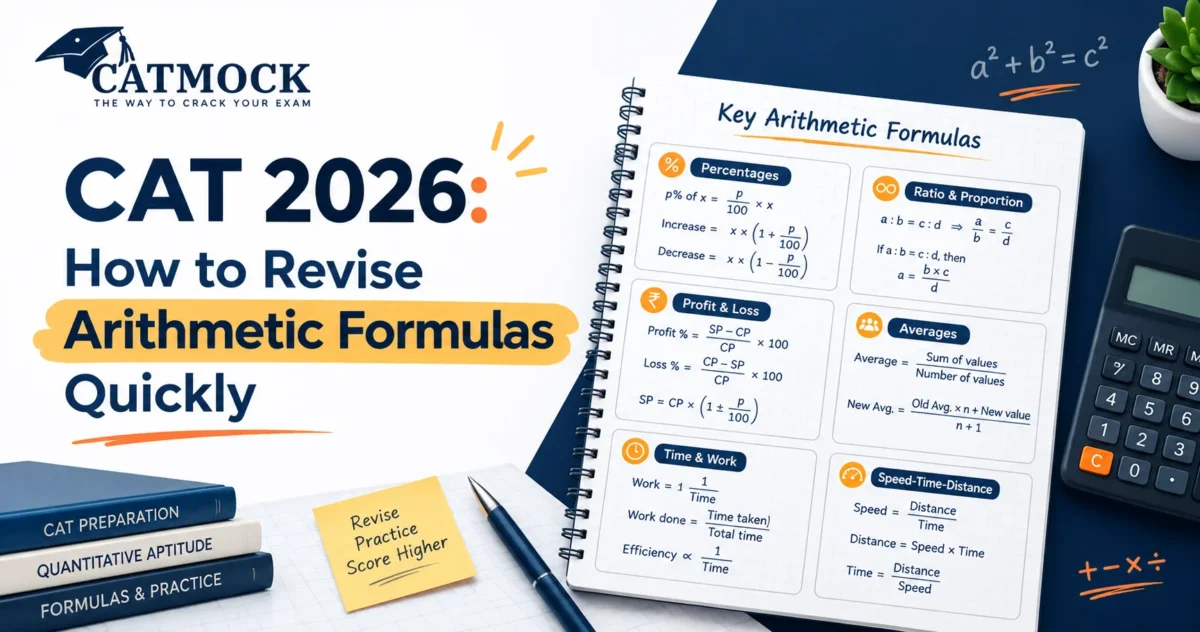
If you searched for CAT arithmetic formulas, you want two things: which formulas actually matter, and how to revise them without rereading a 100-line PDF. This guide gives you a 25-formula sheet, a 20-minute daily routine and a six-week plan.
Short answer: Revise CAT arithmetic formulas by recall, not by rereading. Keep a one-page sheet of about 25 core formulas, write them from memory for five minutes a day, apply each one to two or three questions, and log every miss. Arithmetic usually brings 8 to 10 of the 22 Quant questions, so it pays back your time faster than any other topic.
Why Arithmetic Deserves Your Revision Time
IIM Indore conducts CAT 2026 on 29 November. Recent papers gave the Quant section 22 questions in 40 minutes, which works out to about 1.8 minutes per question. You cannot stop and derive a formula at that pace.
Arithmetic also holds the friendliest questions in Quant: percentages, profit and loss, interest, averages, mixtures, time-speed-distance and time and work. The pattern has changed in past years, so check the official CAT website for the final details before exam day.
Why Rereading Formulas Fails
When you reread a list, you recognise each formula, and recognising feels like knowing. In the exam, nothing on the screen prompts you, so recognition gives you nothing. Recall works differently: you close the page, write the formula, and then check. That small struggle is what makes it stick.
Step 1: Cut Your List to 25 Core CAT Arithmetic Formulas
Most formula PDFs list 100 or more items, and many repeat the same idea in a new outfit. Keep the ones below. Each one saves real time in a CAT question.
Percentages and Profit & Loss
| Formula | Use it for |
|---|---|
| Percentage change = (change ÷ original) × 100 | Any increase or decrease question |
| Successive change = a + b + ab/100 (use a minus sign for a fall) | Two or more changes in a row |
| Up x% then down x% = net fall of x²/100 % | A quick check on rise-then-fall questions |
| SP = CP × (100 + p)/100, so SP : CP = (100 + p) : 100 | Profit on cost price |
| SP = MP × (100 − d)/100 | Discount on marked price |
| Successive discounts a% and b% = a + b − ab/100 | Two discounts together |
| Two items sold at the same price, one at x% profit and one at x% loss = overall loss of x²/100 % | A common trap question |
| Price up r% → cut consumption by r/(100 + r) × 100 % to keep spending the same | Price-consumption problems |
Interest
| Formula | Use it for |
|---|---|
| SI = P × R × T / 100 | Simple interest |
| Amount under CI = P × (1 + R/100)^T | Annual compounding |
| CI − SI for 2 years = P × (R/100)² | Difference questions |
| CI − SI for 3 years = P × (R/100)² × (3 + R/100) | Difference questions |
For half-yearly compounding, halve the rate and double the time.
Averages and Mixtures
| Formula | Use it for |
|---|---|
| Weighted average = (n₁x₁ + n₂x₂) ÷ (n₁ + n₂) | Mixed groups and combined averages |
| Alligation: cheaper : dearer = (d − m) : (m − c), where c is the cheaper price, d the dearer price and m the mean price | Mixing two items |
| Replacement: quantity left = V × (1 − x/V)^n | Repeated removal and refilling |
| Change in average × number of items = change in total | Someone joins, leaves or gets replaced |
Time, Speed, Distance and Work
| Formula | Use it for |
|---|---|
| Quantity = Rate × Time | Distance, work and pipes all use this |
| For a fixed distance, speed and time are inversely proportional | Same-distance comparisons |
| Relative speed = difference (same direction) or sum (opposite directions) | Trains, meetings and catch-ups |
| Average speed over equal distances = 2ab/(a + b) | Round trips |
| Boats: still-water speed = (downstream + upstream)/2; current = (downstream − upstream)/2 | Boats and streams |
| Two workers: time together = ab/(a + b) | Combined work |
| LCM method: take total work as the LCM of the days, then find each person’s units per day | Multi-person work, pipes and cisterns (treat a drain as negative work) |
| km/h to m/s: multiply by 5/18 | Train questions |
| After-meeting trick: if A and B take t_A and t_B to finish after they meet, speed A : speed B = √t_B : √t_A | Two travellers who meet and then continue |
Add a percentage-fraction table to the sheet as well. It lets you skip long calculations.
| Fraction | Percent | Fraction | Percent |
|---|---|---|---|
| 1/3 | 33.33% | 1/11 | 9.09% |
| 1/6 | 16.67% | 1/12 | 8.33% |
| 1/7 | 14.29% | 1/13 | 7.69% |
| 1/8 | 12.5% | 1/14 | 7.14% |
| 1/9 | 11.11% | 1/15 | 6.67% |
| 1/16 | 6.25% |
Step 2: Learn the Families, Not 25 Separate Facts
Your 25 formulas shrink to a handful of ideas once you see the links.
| Core idea | Chapters it covers | What to remember |
|---|---|---|
| Rate × Time = Quantity | Speed, work, pipes | One equation, three chapters |
| Percent = fraction = ratio | Profit and loss, percentages, ratios | A 25% profit means SP : CP = 5 : 4 and a multiplier of 1.25 |
| Weighted average | Averages, alligation, mixtures | Alligation reads a weighted average sideways |
If a basic idea such as ratios or percentages still feels shaky, revisit NCERT’s school mathematics textbooks, which are free on ncert.nic.in.
Step 3: Revise With the 20-Minute Loop
Use this loop every day:
- Recall (5 minutes). Cover your sheet and write eight formulas from memory.
- Check (2 minutes). Compare with the sheet. Circle every miss and every wrong condition.
- Apply (10 minutes). Solve three questions that use the formulas you missed, plus one you got right.
- Log (3 minutes). Write each miss in an error log: the formula, and why you missed it (forgot it, wrong base, wrong condition).
Rotate eight formulas a day, and you cover all 25 in about four days. Then repeat. Bring a missed formula back the next day, and again three days later. Spacing beats cramming.
Step 4: Your Six-Week Plan (17 October to 29 November)
| Week | Dates | Focus |
|---|---|---|
| 1 | 17-23 Oct | Build the one-page sheet and take your first recall test |
| 2 | 24-30 Oct | Percentages, profit and loss, interest |
| 3 | 31 Oct-6 Nov | Averages, mixtures, ratios |
| 4 | 7-13 Nov | Time, speed, distance and work |
| 5 | 14-20 Nov | Mixed sets and one full mock; recall the whole sheet each morning |
| 6 | 21-27 Nov | Error log and sheet only; learn nothing new |
| Last 2 days | 28-29 Nov | Read the sheet lightly and rest |
Test Each Formula Before You Trust It
Run each formula once on a small example. These seven checks take five minutes.
| Formula | Quick test | Result |
|---|---|---|
| Successive change | A price rises 20%, then 25% | 20 + 25 + (20 × 25)/100 = 50% |
| Rise then fall | Up 20%, then down 20% | −(20²)/100 = −4% |
| Equal-distance average speed | 40 km/h out, 60 km/h back | 2 × 40 × 60/100 = 48 km/h |
| Two workers | 12 days and 20 days | (12 × 20)/32 = 7.5 days |
| CI − SI (2 years) | ₹10,000 at 10% | 10,000 × (0.1)² = ₹100 |
| Replacement | 80 L milk, remove 20 L and refill with water, three times | 80 × (3/4)³ = 33.75 L |
| Alligation | Mix ₹60 and ₹90 items to get a ₹72 mean | (90 − 72) : (72 − 60) = 3 : 2 |
Common Mistakes That Make Formulas Fail
- Using the wrong base. Percentage change uses the original value. Profit uses cost price. Discount uses marked price.
- Ignoring the condition. The x²/100 loss rule works only when both items sell at the same price.
- Dropping the sign. Put a minus sign on every fall in a successive-change question.
- Mishandling half-yearly compounding. Halve the rate and double the time.
- Treating a drain as filling. In pipe questions, a drain is negative work.
- Trusting a shortcut you never tested. Try each shortcut on a small number before you rely on it.
Use Mock Tests to Check Your Recall
A formula sheet proves its worth only under time pressure. Take a full mock every week from Week 5, and tag every arithmetic question you miss. Then ask one thing: did I forget the formula, misread the question, or run out of time? Add the answer to your error log. For method shortcuts that cut solving time, read our guide to CAT Quant shortcuts and tricks, and practise under real exam conditions with CatMock mock tests.
Summary
- Revise CAT arithmetic formulas by recall, not by rereading.
- Keep a one-page sheet of 25 core formulas and a percentage-fraction table.
- Learn the links: rate × time, percent-fraction-ratio, and weighted average.
- Run a 20-minute loop daily: recall, check, apply, log.
- Follow the six-week plan, and learn nothing new in the last week.
- Use mocks and your error log to find the formulas that still slip.
Frequently Asked Questions
How many formulas do I need for CAT arithmetic?
You need about 25 core formulas and a percentage-fraction table. Understanding the links between topics covers the rest.
How many arithmetic questions come in CAT Quant?
Recent papers carried about 8 to 10 arithmetic questions out of 22 in the Quant section.
What is the fastest way to revise CAT arithmetic formulas?
Use active recall. Write your formulas from memory for five minutes a day, check them, apply them to a few questions and log every miss.
How long does it take to revise CAT arithmetic formulas?
Plan about a week to build and learn your sheet, then spend 20 minutes a day keeping it fresh until the exam.
Should I memorise formulas or understand them?
Do both. Memorise the sheet, and understand the conditions behind rules such as x²/100, because a formula used in the wrong situation gives a wrong answer.
Which arithmetic topic should I revise first?
Start with percentages. Profit and loss, interest, ratios and averages all build on them.
What should I do in the last two days before CAT?
Read your sheet and error log, solve a few easy questions, and rest. Do not start new topics.
Do I need a formula for every arithmetic question?
No. Many questions fall faster to a simple assumption, such as taking the total as 100 or the total work as the LCM of the days.
Conclusion
Revising CAT arithmetic formulas does not mean reading more. It means testing yourself more. Build your 25-formula sheet this week, run the 20-minute loop every day, and let your error log tell you where to spend the next hour.
You have about six weeks. That is enough to make these formulas automatic, as long as you recall them daily and check them in mocks. Start tonight with eight formulas, and write them without peeking.
You May Also Like : CAT MOCK, CAT MOCK PYQ
Follow Us On : Facebook, Instagram, Youtube