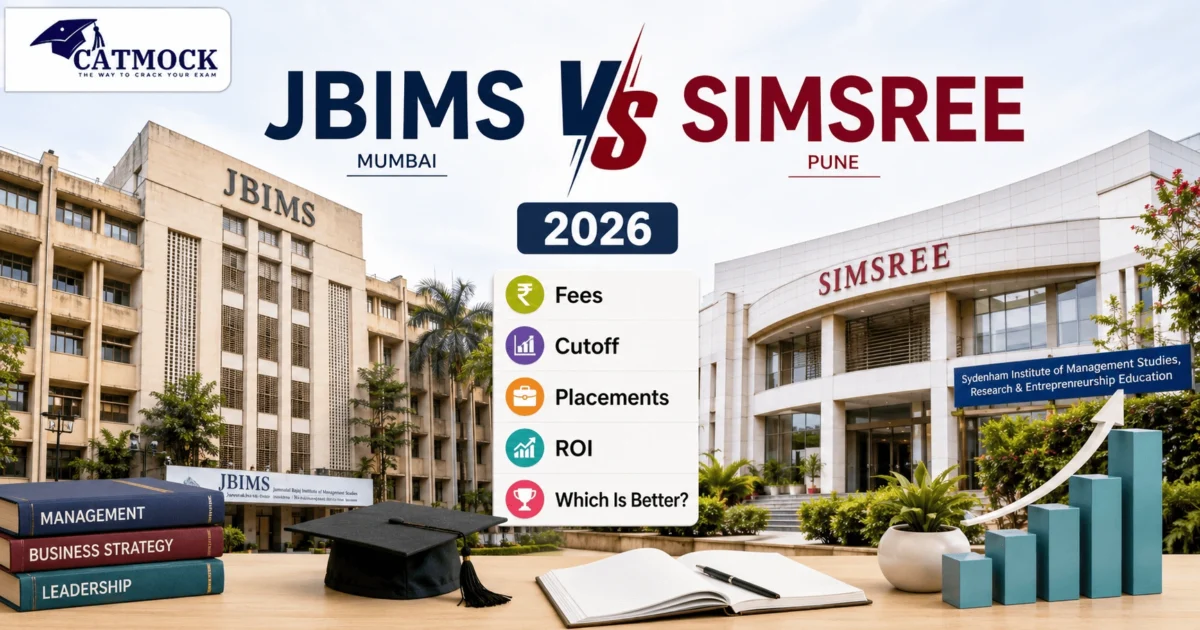
You cracked 99+ percentile in MAH-CET. Now comes the harder question: JBIMS or SIMSREE?
Both are government-backed, both sit a few hundred metres apart in South Mumbai, and both will get you a decent MBA — but the similarities end there. One costs ₹6+ lakhs and hands out ₹26 LPA average packages. The other costs under ₹1.5 lakhs and still delivers a respectable ₹15 LPA average. If you’re staring at your CET scorecard and wondering which form to fill first during the CAP rounds, this comparison can settle that decision with actual numbers—not campus folklore.
JBIMS vs SIMSREE: Quick Comparison at a Glance
| Particulars | JBIMS Mumbai | SIMSREE Mumbai |
|---|---|---|
| Full Name | Jamnalal Bajaj Institute of Management Studies | Sydenham Institute of Management Studies, Research and Entrepreneurship Education |
| Established | 1965 | 1983 |
| Type | Government-aided, affiliated to University of Mumbai | Government, affiliated to University of Mumbai |
| Flagship Programme | MMS (equivalent to MBA) | MMS (equivalent to MBA) |
| Total MMS Seats | ~150–156 | ~180–205 |
| Total Fee (2 Years) | ₹6.2–8.3 Lakhs (varies by source/hostel) | ₹1.35–1.5 Lakhs |
| MAH-CET Cutoff (General) | 99.94–99.99 percentile | 99.85–99.97 percentile |
| Average Package (2025) | ₹26–26.67 LPA | ₹15.1–15.24 LPA |
| Highest Package (2025) | ₹55.6 LPA (up to ₹87 LPA reported by some sources) | ₹22.5–26.3 LPA |
| Placement Rate | 100% | ~98–100% |
Fees Comparison: The Gap Is Bigger Than You’d Expect
This is where the two colleges genuinely diverge. JBIMS’ total 2-year MMS fee sits somewhere between ₹6.2 lakhs and ₹8.3 lakhs depending on the year and whether hostel charges are included — figures vary slightly across official disclosures, so always confirm the current number on JBIMS’ own admission page during CAP counselling. SIMSREE, on the other hand, charges close to nothing by MBA standards: around ₹67,000 per year, or roughly ₹1.35–1.5 lakhs for the full programme.
| Category | JBIMS (Approx. Total) | SIMSREE (Approx. Total) |
|---|---|---|
| Academic Fee (2 yrs) | ₹6.2–6.5 Lakhs | ₹1.34–1.38 Lakhs |
| With Hostel/Mess (Estimate) | ₹8–8.5 Lakhs | ₹2.5–3 Lakhs |
| Application Fee | Included in MAH-CET/CAP process | Included in MAH-CET/CAP process |
For context, both are still dramatically cheaper than private Mumbai B-schools like SPJIMR (₹19–22 lakhs) or NMIMS (₹18–20 lakhs), which is exactly why students who clear MAH-CET rarely look elsewhere first. If you want the full private-vs-government fee picture across Mumbai’s MBA landscape, our comparison of top MBA colleges in Mumbai lays it out side by side.
Cutoff Comparison: How High Do You Need to Score?
Both colleges sit at the very top of the MAH-CET cutoff ladder, and the gap between them is thinner than most aspirants assume — often less than half a percentile point in a good year.
| Category | JBIMS MAH-CET Cutoff | SIMSREE MAH-CET Cutoff |
|---|---|---|
| General (All India) | 99.94–99.99 | 99.85–99.97 |
| OBC | ~99.5–99.8 | ~99.2–99.6 |
| SC | ~95–98 | ~92–96 |
| ST | ~85–92 | ~80–90 |
Both institutes also accept CAT/CMAT scores for a limited set of All-India seats — JBIMS typically expects a CAT percentile in the mid-90s or above for these seats, though the bulk of admissions still run through MAH-CET and Maharashtra’s DTE CAP counselling. If you’re preparing for the CET itself rather than CAT, our MAH-CET exam pattern and syllabus guide breaks down the sectional weightage — Logical Reasoning alone carries 75 of the 200 marks, which is where most percentile is won or lost.
One practical point aspirants often miss: since SIMSREE has roughly 30–50 more seats than JBIMS across categories, a marginal cutoff miss at JBIMS often still gets you into SIMSREE in the very next CAP round, rather than pushing you out of both.
Placements: Where the Real Trade-off Lives
This is the number that actually decides most people’s choice, so it deserves the most scrutiny.
| Metric | JBIMS (2025) | SIMSREE (2025) |
|---|---|---|
| Average Package | ₹26–26.67 LPA | ₹15.1–15.24 LPA |
| Median Package | ₹26.15–26.4 LPA | ₹14.95 LPA |
| Highest Package | ₹55.6 LPA (up to ₹87 LPA per some reports) | ₹22.5–26.3 LPA |
| Companies Visited | 65+ | 76+ |
| Top Recruiting Sector | BFSI & Investment Banking (~49% of offers) | BFSI, Consulting, FMCG (diversified mix) |
| Placement Rate | 100% | ~98–100% |
JBIMS’ placement story is concentrated, with nearly half its offers coming from BFSI and investment banking. This focus reflects the ecosystem that has shaped its brand for over six decades. SIMSREE has a more diverse recruiter base, with banking, consulting, and FMCG contributing meaningful shares. This variety can appeal to students who remain undecided about their specialisation.
The average package gap (~₹11 LPA) is real and consistent year over year, not a one-off fluctuation. If your target career is investment banking, equity research, or top-tier consulting specifically, JBIMS’ recruiter depth in those exact sectors is hard to substitute. If you’re open to a broader mix of roles and want to keep debt-to-income ratio as low as humanly possible, SIMSREE’s numbers still comfortably beat most private MBA colleges charging 8–10x its fee.
ROI Analysis: Which College Actually Pays Off Faster?
Raw package numbers don’t tell the full story — return on investment does. Here’s the math both ways.
| ROI Metric | JBIMS | SIMSREE |
|---|---|---|
| Total Fee | ~₹6.2–8.3 Lakhs | ~₹1.35–1.5 Lakhs |
| Average Package | ~₹26 LPA | ~₹15.2 LPA |
| Fee Recovered In | ~3–4 months of salary | ~1–1.5 months of salary |
| Absolute Salary Advantage | +₹11 LPA over SIMSREE | — |
| ROI Ratio (Package ÷ Fee) | ~3.2x–4x | ~10x+ |
On pure ROI ratio, SIMSREE wins by a wide margin — a fee this low against a ₹15 LPA average package is genuinely hard to beat anywhere in Indian management education, government or private. But ROI ratio isn’t the only lens: if you’re optimising for absolute earning potential and can comfortably afford (or take an education loan for) JBIMS’ fee, the ₹11 LPA average package gap compounds significantly over a 5–10 year career, especially if you’re targeting BFSI or consulting roles where JBIMS’ alumni network carries real weight.
JBIMS vs SIMSREE: Which One Should You Actually Pick?
There’s no universal right answer here — it genuinely depends on what you’re optimising for. Use this as a quick filter:
Pick JBIMS if:
- You’re specifically targeting BFSI, investment banking, or top-tier consulting roles.
- You can afford the ₹6–8 lakh fee comfortably, or are fine taking a small education loan against a strong expected ROI.
- You value the “CEO Factory” brand recognition, which still carries disproportionate weight in Mumbai’s corporate and finance circles.
- Your MAH-CET percentile comfortably clears 99.9+.
Pick SIMSREE if:
- Minimising financial risk matters more to you than maximising the absolute package.
- You want a diversified placement pool (BFSI + consulting + FMCG) rather than a BFSI-heavy skew.
- Your MAH-CET percentile is strong but sits closer to 99.85–99.9, where JBIMS becomes a stretch.
- You’re comparing this decision against a private B-school charging 8–10x more for a similar or lower package — in which case SIMSREE’s ROI is very hard to beat.
Both are legitimate, well-regarded government MBA options — the “better” one is really a function of your risk tolerance and career target, not a fixed hierarchy. Our broader roundup of top government MBA colleges in India puts both institutes in context against FMS Delhi, the newer IIMs, and other high-ROI options if you’re still weighing your full option set.
Common Mistakes Aspirants Make While Choosing
- Chasing the JBIMS brand without checking sector fit. If your interest is marketing or HR rather than BFSI, JBIMS’ recruiter concentration may not serve you as well as the brand name suggests.
- Underestimating SIMSREE because of the lower package number. A ₹15 LPA average on a ₹1.5 lakh fee is objectively excellent ROI — dismissing it purely on relative comparison to JBIMS is a common but avoidable error.
- Ignoring the CAP round sequencing. Since both admit through Maharashtra’s centralised DTE CAP process, understanding round-wise seat matrix movement matters as much as your raw percentile.
- Assuming fees are fixed year to year. Government college fees do get revised periodically — always verify current figures directly during registration rather than relying on last year’s numbers.
Key Takeaways
- JBIMS costs roughly 4–6x more than SIMSREE but delivers close to double the average placement package.
- Cutoffs are close — often within half a percentile — so a near-miss at JBIMS frequently still clears SIMSREE.
- JBIMS’ placements skew heavily toward BFSI and investment banking; SIMSREE’s recruiter base is more diversified.
- On pure ROI ratio, SIMSREE is arguably unbeatable; on absolute earning potential, JBIMS pulls ahead.
- Both are excellent, low-risk government MBA options compared to private B-schools charging significantly more for similar or lower outcomes.
- The right choice depends on your target sector, risk appetite, and how close your MAH-CET percentile is to each cutoff.
Frequently Asked Questions
Q1. Is JBIMS better than SIMSREE for placements?
In terms of average and highest package, yes — JBIMS’ 2025 average of ~₹26 LPA is significantly higher than SIMSREE’s ~₹15 LPA. However, “better” depends on your target sector: JBIMS is stronger in BFSI and investment banking specifically, while SIMSREE offers a more diversified recruiter mix across banking, consulting, and FMCG.
Q2. What is the fee difference between JBIMS and SIMSREE?
JBIMS’ total 2-year MMS fee ranges from roughly ₹6.2 to ₹8.3 lakhs depending on hostel inclusion and the specific year, while SIMSREE’s total fee is around ₹1.35–1.5 lakhs — making SIMSREE one of the most affordable MBA options with strong placement outcomes in India.
Q3. What MAH-CET percentile is needed for JBIMS and SIMSREE?
JBIMS typically requires a 99.94–99.99 percentile in the General category, while SIMSREE’s cutoff runs slightly lower at 99.85–99.97 percentile. Both cutoffs vary by category (OBC, SC, ST, EWS) and by CAP round, so it’s worth tracking the official seat allotment updates during counselling rather than relying only on the previous year’s figures.
Q4. Which college has better ROI, JBIMS or SIMSREE?
On a pure ROI ratio (package divided by fee), SIMSREE wins clearly — its fee is recovered in about a month of salary versus 3–4 months at JBIMS. On absolute earning potential, JBIMS pulls ahead due to its significantly higher average package, so the “better ROI” answer depends on whether you’re optimising for ratio or absolute number.
Q5. Can I get into JBIMS or SIMSREE through CAT instead of MAH-CET?
Yes, both institutes accept CAT and CMAT scores for a limited number of All-India seats, though the majority of admissions happen through MAH-CET followed by Maharashtra’s DTE CAP counselling process. If CAT is your primary exam, it’s still worth registering for MAH-CET as a parallel option given the extra seats it opens up.
Conclusion
JBIMS and SIMSREE aren’t really competitors in the traditional sense — they’re two different bets on the same government-MBA opportunity in Mumbai. JBIMS bets on brand depth and BFSI-heavy placements at a real but manageable fee; SIMSREE bets on near-zero financial risk with genuinely strong, diversified outcomes. Neither is the “wrong” choice at 99+ percentile — the mistake would be picking one without being honest about which trade-off actually matches your career goals and financial comfort.
If you’re still building toward that percentile, start with a free MAH-CET-style mock test to gauge where you currently stand, and pair it with daily practice sets for Logical Reasoning and Quant — the two sections that separate a 99.5 from a 99.9 in this exam. For official fee structures, seat matrices, and CAP round schedules, always cross-check with Maharashtra’s State CET Cell and the University of Mumbai, since both institutes are directly affiliated to it.
You May Also Like : CAT MOCK / CAT MOCK PYQ
Follow Us On : Facebook / Instagram