Every year, thousands of MBA aspirants lose a seat before they attempt a single question. The reason is rarely weak aptitude. It is a missed clause: a category certificate in the wrong format, a form submitted with an error that can’t be corrected, a photo that doesn’t match the rules, a fee paid late. All of these rules were printed in one document the candidate never read properly.
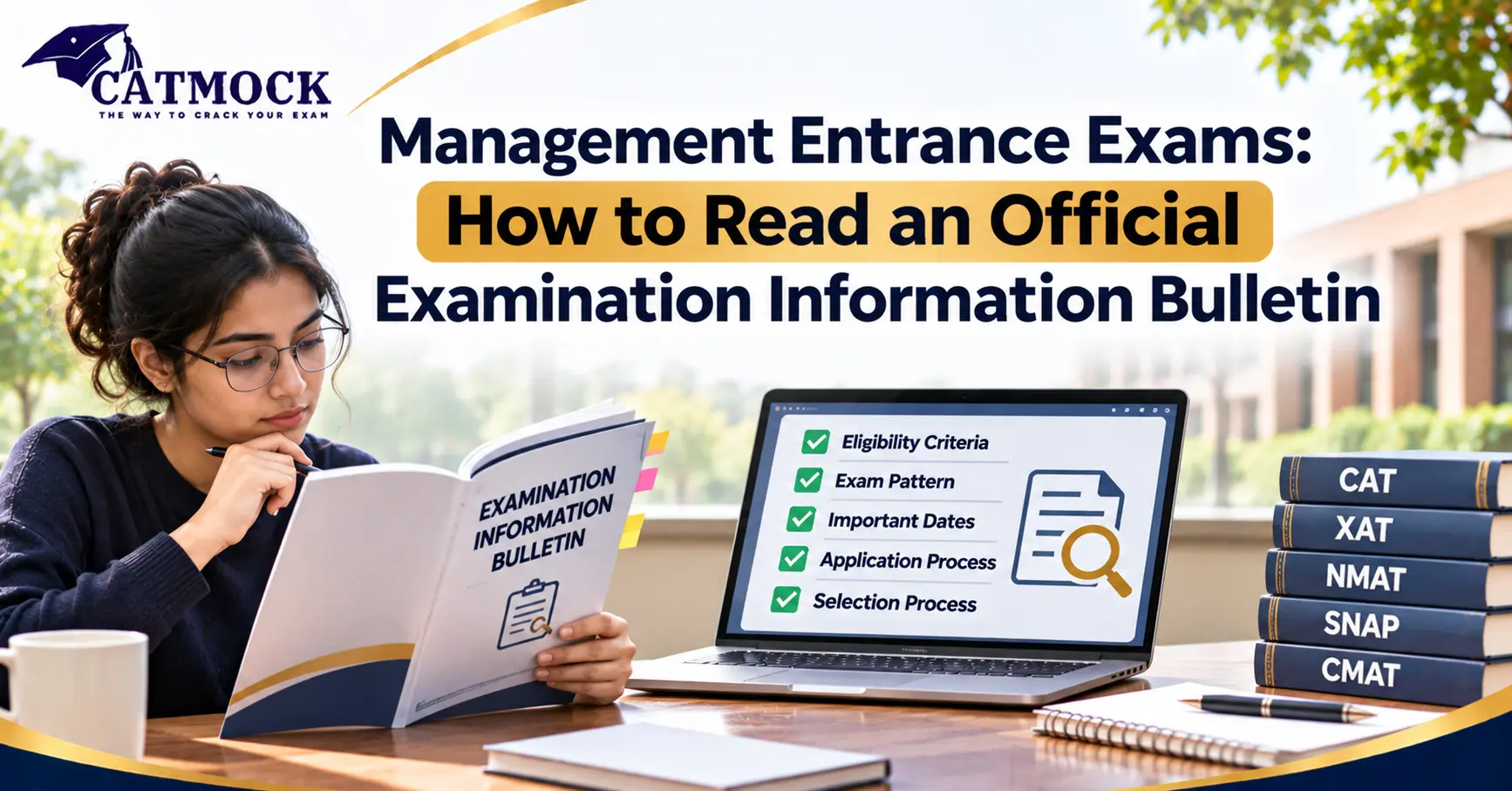
That document is the official examination information bulletin, also called the brochure or notification PDF. This guide shows you how to read it for management entrance exams such as CAT, XAT, SNAP, NMAT and CMAT. You’ll get a reading order, a section-by-section decoder, a red-flag list and a checklist you can use before you click “submit.”
Quick Answer: What Is an Information Bulletin and How Should You Read It?
An information bulletin is the binding rulebook for an entrance exam, published by the conducting authority. It states who can apply, how to apply, when each step happens, how the test is scored and what can get you disqualified. To read it well:
- Download it only from the official exam website.
- Read eligibility and dates first.
- Then read fees, application rules, pattern and marking.
- Finish with the fine print on documents, corrections and disqualification.
- Keep a saved copy for the whole admission cycle.
If a coaching blog, social media post or friend’s message disagrees with the bulletin, the bulletin wins.
Why Reading the Official Bulletin Matters in Management Entrance Exams
Management entrance exams are run by different bodies, and each writes its own rules. Some are conducted by a rotating group of institutes, some by a university or institute, and some by a national testing agency. Format, fee structure, document rules and correction policies change from one exam to the next, and sometimes from one year to the next.
Three reasons make the bulletin your most important study document, even though it contains no questions:
- It is legally binding. Courts and exam authorities treat it as the final word. A rule in the bulletin applies to you whether you read it or not.
- It changes. Application windows, fees, test cities and pattern details can differ from last year’s. Last year’s blog post is not this year’s bulletin.
- Mistakes are often permanent. Reports on the CAT 2026 bulletin note that no change in category is permitted after the application is submitted, and that incorrect information or a process violation found at any stage can lead to immediate disqualification. NTA’s CMAT bulletin likewise says corrections sent by post, fax, WhatsApp, email or by hand will not be entertained.
Reading carefully costs you an hour. A missed clause can cost you a year.
Bulletin, Brochure, Notification, Advertisement: What’s the Difference?
Candidates often use these words interchangeably, but they are not the same thing. Knowing the difference stops you from relying on a summary when you need the source.
| Term | What it usually is | Reliability for decisions |
|---|---|---|
| Advertisement / short notice | A brief newspaper or web announcement that the exam exists, with headline dates | Low. It is a pointer, not the rules. |
| Notification | The official announcement, often a short document with key dates | Medium. It may lack detail. |
| Information bulletin / brochure | The full rulebook on eligibility, process, pattern and conduct | High. This is the document to follow. |
| Replica of application form | A sample of the online form | High for planning, since it shows what data you’ll need |
| News or coaching articles | Third-party summaries | Useful for speed, but verify against the bulletin |
CatMock’s own guides, such as the CAT 2026 exam guide and the CAT 2026 eligibility criteria guide, are built from official bulletins. Even so, treat any summary, ours included, as a map and the bulletin as the territory.
Where to Find the Official Bulletin Safely
Always start at the conducting body’s website, never at a forwarded PDF.
| Exam | Where to look |
|---|---|
| CAT | The official CAT website, iimcat.ac.in |
| XAT | The official XAT website, xatonline.in |
| SNAP | The official SNAP website, snaptest.org |
| CMAT | The National Testing Agency, nta.ac.in |
| NMAT | The test owner’s official NMAT page, gmac.com/nmat |
How to Read an Official Examination Information Bulletin: A Step-by-Step Method
Most bulletins run 20 to 40 pages. Reading them front to back is slow and tiring. Use this order instead, so the rules that can eliminate you come first.
Step 1: Read “Important Dates” and “Eligibility” First
These two sections decide whether you can apply and by when.
- Note the registration opening and closing dates, the correction window, the admit card date and the exam date.
- Check the minimum qualification, percentage or CGPA rule, and whether final-year students can apply.
- Look for how the percentage is calculated, because some bulletins define it differently from your university.
For a CAT-specific walk-through of these clauses, see our CAT 2026 eligibility criteria guide.
Step 2: Read the Fee and Payment Rules
Check the fee for your category, the accepted payment modes and the refund policy. Many bulletins state that fees are non-refundable. Note what to do if money is deducted but the payment doesn’t register.
Step 3: Read the Application Procedure and the Replica Form
Before you open the live form, read how the process works step by step and study the replica. Then gather everything it asks for:
- A scanned photograph and signature in the required size and format
- Class 10, 12 and graduation details
- Category and sub-category details
- Work experience details, if asked
- A working email ID and mobile number
Step 4: Read the Exam Pattern and Marking Scheme
This section tells you the number of sections, questions, time per section, question types and the penalty for wrong answers. For XAT, for example, negative marking rules affect how you attempt questions. Our XAT negative marking guide explains how that affects strategy.
Step 5: Read Reservation, Category and Document Rules
This is where most avoidable rejections happen. Look for:
- The exact format of category certificates (such as the cut-off date or issuing authority)
- Rules for PwD candidates, including scribe and extra-time provisions
- Whether you must upload documents now or only at the admission stage
Step 6: Read Test City, Admit Card and Exam-Day Instructions
Check how many city preferences you can give, whether the allotted city can differ from your choice, what ID you need, what you can carry and what the on-screen tools allow. Our XAT calculator guide shows how one such rule works in practice.
Step 7: Read the Fine Print: Corrections, Disqualification and Grievances
Finish with the unglamorous sections. They state the correction window, which fields are locked, what counts as malpractice, how results and scorecards work, and how long scores remain valid.
Bulletin Anatomy: What Each Section Tells You
Use this table as a decoder while you read.
| Bulletin section | What to look for | Why it matters |
|---|---|---|
| About the exam / conducting body | Who conducts it and which institutes accept the score | Confirms the exam fits your target colleges |
| Important dates | Registration, correction, admit card, exam and result dates | A missed date usually cannot be recovered |
| Eligibility | Degree, percentage, final-year rules, professional degrees | Applying while ineligible wastes the fee |
| Reservation policy | Category percentages and certificate rules | Wrong or late certificates can cancel a category benefit |
| Application process | Registration, form, uploads, payment, final submission | Tells you which steps are irreversible |
| Fee details | Fee by category, payment modes, refund terms | Avoids duplicate or failed payments |
| Scheme of examination | Sections, duration, question types, marking | Shapes your mock-test strategy |
| Test cities | Number of preferences, allotment rules | Affects your travel and exam-day planning |
| Admit card and ID rules | Download dates, accepted IDs, items allowed | Prevents entry problems on exam day |
| Unfair means and disqualification | Prohibited acts and penalties | One violation can end your candidature |
| Results and score validity | Result date, scorecard, validity period | Tells you how long the score can be used |
| Admission process note | Which institutes run their own WAT/GD/PI | Explains what happens after the exam |
Red Flags and Fine-Print Clauses You Should Never Skip
Some clauses look routine but carry heavy consequences. Search the PDF (Ctrl+F) for these words: disqualified, final, non-refundable, not permitted, must, only, will not be entertained.
| Clause type | What it usually says | What you should do |
|---|---|---|
| “Incorrect information will lead to disqualification” | Any false or mismatched detail can cancel candidature | Cross-check every field with your certificates before submitting |
| “No change after submission” | Fields such as category, name or exam choices are locked | Decide carefully; use the correction window for allowed fields only |
| “Fee is non-refundable” | Failed registrations don’t return the money | Pay once, save the receipt and note the transaction ID |
| “Corrections only through the portal” | Emails, calls and messages won’t change your form | Never rely on writing to the helpdesk to fix a mistake |
| “Certificate must be in prescribed format” | Old or wrongly formatted category documents are rejected | Apply for the correct certificate early |
| “Allotted city may differ” | Your first-choice city is not guaranteed | Give realistic preferences, and keep travel buffer |
| “Items not allowed in the exam hall” | Phones, watches and notes are banned | Read the list and pack accordingly |
| “Scores valid for a limited period” | Scores expire for the next admission cycle | Plan whether a retake makes sense |
Mini Case Study: Reading One Clause Properly
Imagine two candidates, Riya and Aman, both from a reserved category.
Riya skims the bulletin and uploads an old certificate she already had. Aman uses the “Reservation” and “Documents” sections, notices a validity and format requirement, and applies for a fresh certificate before the deadline. Both score the same percentile. When institutes verify documents, Riya’s old certificate is questioned and Aman’s is accepted.
Nothing in the exam changed between them. One candidate read a clause, and the other didn’t. That is the entire purpose of this guide.
How to Compare Bulletins Across Management Entrance Exams
If you are applying to more than one exam, build a one-page comparison. Do not assume a rule that applies to one exam applies to another. For example, the CMAT schedule for the next cycle is published separately: the NTA calendar lists the CMAT date as February 7, 2027, but you should always confirm it in the CMAT bulletin itself.
A simple comparison sheet should cover:
| Field to compare | CAT | XAT | SNAP | NMAT | CMAT |
|---|---|---|---|---|---|
| Conducting body | Note from bulletin | Note from bulletin | Note from bulletin | Note from bulletin | Note from bulletin |
| Registration window | |||||
| Fee by category | |||||
| Marking scheme and negative marking | |||||
| Test-city rules | |||||
| Score validity | |||||
| Correction window |
Fill this from the official PDFs only. For exam-by-exam overviews and practice, see our About Exams page, the free PYQ practice and the mock test categories.
Pre-Submission Checklist: Before You Click “Final Submit”
Use this list for every exam. Tick each item against the bulletin, not against memory.
- I downloaded the bulletin from the official website and saved a dated copy.
- I have confirmed my eligibility, including how my percentage or CGPA is calculated.
- I know the registration, correction, admit card and exam dates.
- I know the fee for my category and the payment steps.
- My photo and signature meet the stated size and format.
- My category and sub-category match my certificate, and the certificate is in the required format.
- My name, date of birth and academic details match my documents exactly.
- I have chosen test-city preferences realistically.
- I know the exam pattern, section timing and marking scheme.
- I understand which fields cannot be changed after submission.
- I have saved the confirmation page, application number and payment receipt.
- I know what ID and items are allowed on exam day.
Common Mistakes Candidates Make While Reading Bulletins
- Reading only a news summary. Summaries skip the clauses that cause rejections.
- Using last year’s bulletin. Rules, fees and dates change.
- Ignoring the replica form. Surprises during live filling cause rushed mistakes.
- Leaving it to the last day. Server load and payment issues multiply near deadlines.
- Trusting hearsay. Friends and groups repeat rumors. The bulletin doesn’t.
- Not saving a copy. Websites update, and you may need the original wording later.
How to Turn Bulletin Knowledge into a Better Exam Strategy
The bulletin is not only an application document. Its pattern and marking sections should shape your preparation:
- Match mocks to the pattern. Practice with timing and section rules identical to the bulletin. CatMock’s full-length and sectional test series is built around current patterns.
- Train around the penalty. Your attempt strategy depends on the marking scheme.
- Plan the calendar backward. Count backward from the exam date and fix mock tests, revision and application tasks.
- Use previous year questions. PYQ practice shows how the pattern behaves in practice.
- Look ahead to admissions. Once scores arrive, tools like the IIM college predictor help you shortlist.
Summary
- The official examination information bulletin is the binding rulebook for a management entrance exam, and it overrides every summary.
- Download it only from the conducting body’s website and save a dated copy.
- Read in this order: dates and eligibility, fees, application process, pattern and marking, category and document rules, exam-day rules, then the fine print.
- Search for words like “disqualified,” “non-refundable” and “not permitted” to catch high-risk clauses.
- Keep a one-page comparison if you are applying to several exams.
- Use the pre-submission checklist before every final submit.
- Let the pattern and marking sections guide how you practice.
Frequently Asked Questions (FAQs)
1. What is an official examination information bulletin?
It is the full rulebook published by an exam’s conducting authority. It covers eligibility, dates, fees, application steps, exam pattern, marking, reservation rules and disqualification clauses. And it is also called a brochure or notification PDF.
2. Is an information bulletin the same as a notification?
Not exactly. A notification or advertisement announces the exam and key dates. The information bulletin is the detailed document with the actual rules. When the two differ in detail, follow the bulletin.
3. Where can I download the bulletin for management entrance exams?
Download it from the official website of the conducting body, such as the CAT, XAT, SNAP or NMAT websites, or the National Testing Agency website for CMAT. Avoid forwarded PDFs and unofficial download pages.
4. Which sections of the bulletin should I read first?
Read the important dates and eligibility sections first, because they decide whether you can apply and by when. Then read the fee, application procedure, exam pattern, and category and document rules.
5. Can I fix mistakes after submitting my application?
It depends on the exam. Many bulletins allow limited corrections in a set window and lock certain fields, such as category. Some authorities will not accept corrections by email, post or messaging apps. Read the correction clause before you submit.
6. Do bulletin rules change every year?
They can. Dates, fees, test cities, pattern details and document rules are updated from cycle to cycle, so always use the current year’s bulletin, not an old copy.
7. How long does it take to read a bulletin properly?
Plan about 60 to 90 minutes for a first careful read, plus extra time for the replica form. That is a small cost compared with the risk of a rejected application.
Conclusion
Learning how to read an official examination information bulletin is one of the cheapest and highest-return skills in MBA preparation. It protects your application, sharpens your strategy and keeps you calm when deadlines arrive. Download from the official source, follow the reading order, decode each section, hunt for the red-flag clauses and finish with the checklist.
Once your application is safe, put your energy where it counts: timed practice that matches the pattern you just read. Start with CatMock’s free mock tests and daily practice, and keep your bulletin open as your reference for every exam you plan to sit.
You May Also Like : CAT MOCK, CAT MOCK PYQ
Follow Us On : Facebook, Instagram, Youtube