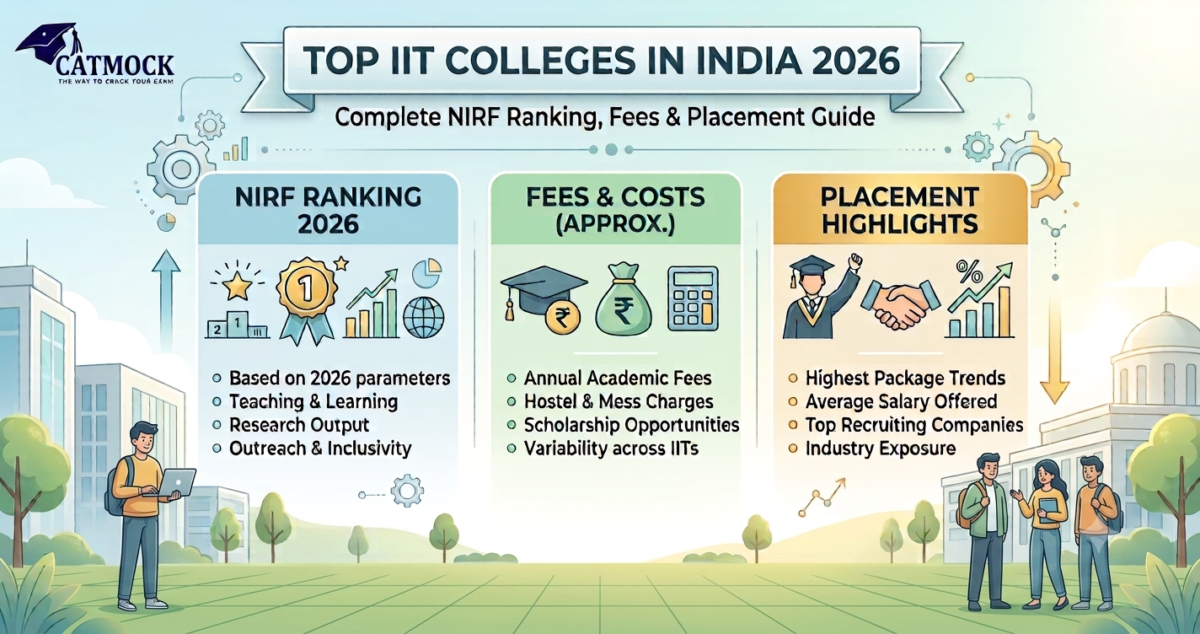
Every year, lakhs of engineering aspirants sit for JEE Advanced with one goal in mind — securing a seat at one of the top IIT colleges in India. The Indian Institutes of Technology are not just engineering schools; they are institutions of national importance that have shaped India’s technology, research, and startup ecosystem for over seven decades.
If you’re trying to shortlist the best IIT colleges in India based on NIRF ranking, fees, placements, and campus life, this guide brings everything together in one place — clean tables, verified data, and answers to the questions students ask most.
What Makes IITs the Top Engineering Colleges in India?
The Indian Institutes of Technology operate under the Institutes of Technology Act, 1961, and are governed centrally by the Ministry of Education through the IIT Council. Currently, there are 23 IITs functioning across the country, ranging from legacy institutes like IIT Kharagpur (established 1951) to newer campuses such as IIT Bhilai and IIT Dharwad, both set up in 2016.
What sets the top IIT colleges in India apart from other engineering institutions is a combination of factors:
- Rigorous admission through JEE Advanced, keeping the acceptance rate under 1%
- Heavy government funding for research infrastructure and faculty
- A faculty-to-student ratio between 1:6 and 1:8, among the best in the country
- Strong industry partnerships with global recruiters like Google, Microsoft, Amazon, and Goldman Sachs
- A globally recognised alumni network spanning technology, finance, and public policy
Top IIT Colleges in India: NIRF Ranking 2025
The National Institutional Ranking Framework (NIRF) remains the most trusted benchmark for ranking Indian engineering colleges. Based on NIRF 2025 data, here is the current list of top IIT colleges in India rank-wise:
| NIRF Rank | IIT Name | State/City | Year Established |
| 1 | IIT Madras | Chennai, Tamil Nadu | 1959 |
| 2 | IIT Delhi | New Delhi | 1961 |
| 3 | IIT Bombay | Mumbai, Maharashtra | 1958 |
| 4 | IIT Kanpur | Kanpur, Uttar Pradesh | 1959 |
| 5 | IIT Kharagpur | Kharagpur, West Bengal | 1951 |
| 6 | IIT Roorkee | Roorkee, Uttarakhand | 1847 (IIT status 2001) |
| 7 | IIT Hyderabad | Hyderabad, Telangana | 2008 |
| 8 | IIT Guwahati | Guwahati, Assam | 1994 |
| 10 | IIT (BHU) Varanasi | Varanasi, Uttar Pradesh | 1919 (IIT status 2012) |
| 12 | IIT Indore | Indore, Madhya Pradesh | 2009 |
IIT Madras has held the number one position in the NIRF Engineering category for nine consecutive years, driven by its research output, entrepreneurship ecosystem, and industry collaboration through its on-campus research park.
A Closer Look at the Top 5 IIT Colleges in India
IIT Madras — Research Powerhouse
IIT Madras consistently tops NIRF rankings thanks to its strong publication record, patent filings, and collaboration with ISRO on aerospace research. Its incubation cell has produced hundreds of startups, and it operates one of the largest research parks of any Indian university.
IIT Delhi — Industry and Innovation Hub
Located in the national capital, IIT Delhi benefits from proximity to government bodies, embassies, and corporate headquarters. It has a strong reputation in artificial intelligence, machine learning, and has produced several unicorn startup founders.
IIT Bombay — The Placement Leader
Set up in 1958 with support from UNESCO, IIT Bombay is widely regarded as the toughest IIT to get into for Computer Science. Its Powai campus culture, entrepreneurship cell (E-Cell), and international placement packages make it a top choice among JEE Advanced toppers.
IIT Kanpur — Core Engineering Excellence
Known for its rigorous academic culture, IIT Kanpur has built a strong reputation in aerospace, computer science, and cybersecurity research, along with one of India’s oldest computer science departments.
IIT Kharagpur — The Largest Campus
As the oldest IIT, Kharagpur boasts the largest campus among all IITs, with sprawling infrastructure, a diverse range of departments, and a legacy alumni base that spans multiple decades.
Top IIT Colleges Fee Structure (BTech Programme)
Affordability remains one of the strongest reasons students prioritise top IIT colleges in India over private universities, even with a comparable or better return on investment.
| IIT | Approx. Total BTech Fee (4 Years) | Annual Fee (Approx.) |
| IIT Bombay | ₹8–9 lakh | ₹2.2 lakh |
| IIT Delhi | ₹8–9 lakh | ₹2.2 lakh |
| IIT Madras | ₹8–9 lakh | ₹2.2 lakh |
| IIT Kanpur | ₹8–9 lakh | ₹2.2 lakh |
| IIT (BHU) Varanasi | ₹8.35 lakh | ₹2.1 lakh |
| IIT Hyderabad | ₹11.94 lakh | ₹2.9 lakh |
The government subsidises undergraduate tuition by nearly 80%, which is why the total four-year cost across most top IITs stays under ₹9 lakh — remarkably low compared to the placement packages these institutes generate.
Placement Packages at the Best IIT Colleges
Placements are often the single biggest deciding factor for students comparing the top IIT colleges in India. Here’s how the leading institutes stack up on median and highest packages:
| IIT | Median Package (UG) | Highest Package (Reported) |
| IIT Bombay | ₹20+ LPA | International offers, highest overall |
| IIT Delhi | ₹18–20 LPA | Strong ties with Google, Microsoft, Amazon |
| IIT Madras | ₹18–20 LPA | Avg. package ₹37.5 LPA |
| IIT Hyderabad | ₹21 LPA | Among highest UG median packages |
| IIT Roorkee | ₹15 LPA | Strong core engineering placements |
| IIT (BHU) Varanasi | ₹20 LPA | Best ROI (139.52%) relative to fees |
IIT Bombay continues to record the lowest JEE Advanced cutoff ranks for Computer Science and Engineering, reflecting how competitive admission to its CSE branch has become relative to other top IIT colleges in India.
Best IIT for Popular Branches
Choosing among the top IIT colleges in India isn’t just about overall rank — the right branch matters just as much.
- Computer Science & Engineering (CSE): IIT Bombay (placements), IIT Delhi (AI/ML research), IIT Kanpur (cybersecurity)
- Mechanical Engineering: IIT Madras, IIT Kharagpur, IIT Kanpur
- Aerospace Engineering: IIT Madras (ISRO collaboration), IIT Bombay (aerodynamics labs), IIT Kanpur (UAV research)
- Electrical Engineering: IIT Delhi, IIT Bombay, IIT Kanpur
- Civil Engineering: IIT Roorkee, IIT Kharagpur, IIT Madras
Old IITs vs New IITs: Which Should You Choose?
A common dilemma among JEE Advanced qualifiers is choosing between legacy institutes and newer IITs.
| Parameter | Old IITs (Bombay, Delhi, Madras, Kanpur, Kharagpur) | New IITs (Hyderabad, Indore, Bhilai, Dharwad, etc.) |
| Alumni network | Extensive, decades old | Growing rapidly |
| Infrastructure | Fully developed | Modern but still expanding |
| Placement history | Long-standing, high consistency | Improving year on year |
| Cutoff ranks | Higher (more competitive) | Comparatively lower |
| Research output | Very high | Rising steadily |
New IITs like IIT Hyderabad and IIT Indore are closing the gap quickly, with strong industry connect and rapidly improving NIRF rankings, making them worth considering when cutoffs at older IITs are out of reach.
How to Get Admission into the Top IIT Colleges in India
Admission to any of the top IIT colleges in India follows a structured, merit-based process:
- Clear JEE Main – Qualify among the top percentile of candidates nationally.
- Appear for JEE Advanced – Only top JEE Main rankers are eligible to sit for this exam.
- Register for JoSAA Counselling – The Joint Seat Allocation Authority conducts multiple rounds of seat allotment based on rank, category, and branch preference.
- Choice Filling – List preferred IITs and branches in order of priority.
- Seat Acceptance & Document Verification – Complete the reporting formalities at the allotted institute.
Candidates should track category-wise cutoff trends closely, since cutoffs for CSE at institutes like IIT Bombay, IIT Delhi, and IIT Madras remain the toughest in the country year after year.
Summary: Top IIT Colleges in India at a Glance
| Category | Key Takeaway |
| Total IITs in India | 23 institutes, plus overseas campuses in Zanzibar and the UAE |
| No. 1 Ranked IIT (NIRF 2025) | IIT Madras |
| Top 3 IITs Overall | IIT Madras, IIT Delhi, IIT Bombay |
| Best for CSE | IIT Bombay, IIT Delhi, IIT Kanpur |
| Best ROI | IIT (BHU) Varanasi |
| Admission Route | JEE Main → JEE Advanced → JoSAA Counselling |
| Average 4-Year Fee | Under ₹9 lakh at most old IITs |
Frequently Asked Questions
1. Which are the top IIT colleges in India in 2026?
Based on NIRF 2025 rankings, IIT Madras, IIT Delhi, and IIT Bombay are considered the top IIT colleges in India, followed by IIT Kanpur and IIT Kharagpur.
2. How many IITs are there in India?
There are currently 23 IITs functioning across India, along with two overseas campuses — one in Zanzibar, Tanzania, and one in the UAE.
3. Which IIT is best for Computer Science Engineering?
IIT Bombay is widely regarded as the best for CSE due to its placement record and low JEE Advanced cutoffs, followed closely by IIT Delhi and IIT Kanpur.
4. What is the admission process for top IIT colleges in India?
Admission requires clearing JEE Main, qualifying for JEE Advanced, and securing a seat through JoSAA counselling based on category-wise rank and branch preference.
5. What is the average fee at top IIT colleges in India?
The total BTech course fee across most top IITs is under ₹9 lakh for four years, thanks to government subsidies covering nearly 80% of tuition costs.
6. Which IIT offers the best placement packages?
IIT Bombay and IIT Madras report some of the highest median and average placement packages among all IITs, with IIT Madras averaging around ₹37.5 LPA.
7. Are new IITs worth choosing over older IITs?
Yes — newer IITs like IIT Hyderabad and IIT Indore have rapidly improving infrastructure, research output, and placements, making them strong alternatives when cutoffs at older IITs are difficult to reach.
Conclusion
Choosing among the top IIT colleges in India comes down to more than just an overall rank. Students should weigh NIRF standing alongside branch strength, placement history, fee structure, and long-term career goals. While IIT Madras, IIT Delhi, and IIT Bombay remain the most sought-after institutes nationally, several new IITs are closing the gap fast with modern infrastructure and improving placement records. Ultimately, the “best” IIT is the one that aligns with your JEE Advanced rank, branch interest, and career direction — not just its position on a ranking list.
For official and most up-to-date rankings, refer to the NIRF India portal and the JoSAA official website for admission and counselling schedules.
You May Also Like : CAT MOCK, CAT MOCK PYQ
Follow Us On : Facebook, Instagram