
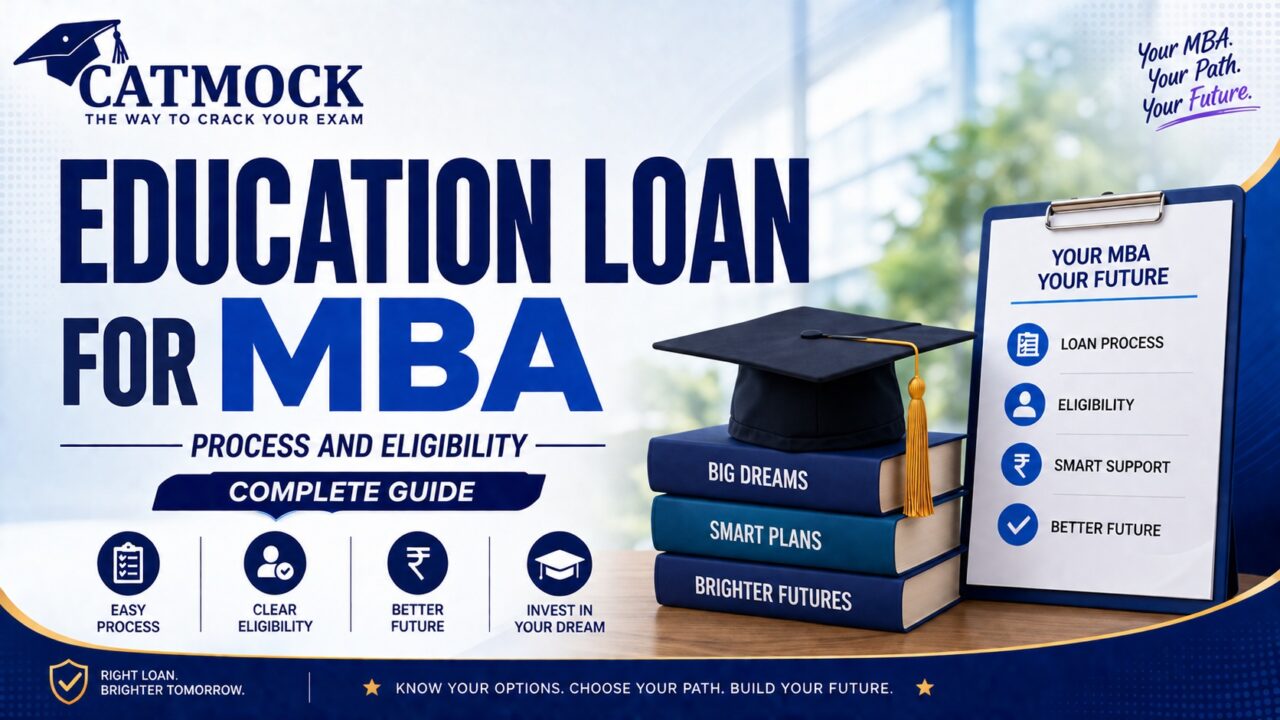
Tuition at premier institutes like the top IIMs now runs well past ₹25 lakh, and many private B-schools charge ₹15–25 lakh for the full program. Because of this, most MBA admits — even from financially comfortable families — end up financing at least part of the degree through an education loan rather than paying entirely out of pocket.
This guide walks through exactly how an MBA Education loan works in India: who qualifies, what’s covered, how collateral requirements differ across lenders, how banks compare on interest rates, the newer government-backed PM Vidyalaxmi scheme, the documents you’ll need, and the full step-by-step process from pre-admission sanction to final disbursal.
Why this matters: An education loan isn’t a single standardized product. A public sector bank, a private bank, and an NBFC can offer meaningfully different interest rates, collateral rules, and processing speed for the exact same admission letter. Comparing three to four lenders before committing isn’t optional due diligence—it can be the difference between an 8% and a 14% interest rate on the same loan amount.

Who Can Take an Education Loan for an MBA?
Eligibility for an MBA loan is assessed on two fronts at once: your own academic and admission profile and your co-applicant’s income and credit history.
- Indian nationals (including NRIs and, under some schemes, Overseas Citizens of India) with confirmed admission to a recognised MBA/PGP programme, domestic or international
- A bachelor’s degree, along with mark sheets from Class 10, Class 12, and graduation, as part of the academic record every lender reviews
- A co-applicant—usually a parent, spouse, or sibling with stable, verifiable income—is required by most banks, especially for secured loans and higher loan amounts
- Admission through the regular selection process; loans against management-quota seats are explicitly excluded from several government-backed schemes, including PM Vidyalakshmi
Key insight: A strong admission letter from a top institute can meaningfully ease the co-applicant income requirement, since lenders treat placement track record as a proxy for repayment capacity.
Types of Education Loans for MBA.
Broadly, three categories of lenders offer education loans for MBA students in India, each with a different risk appetite and processing style.
| Lender Type | Typical Interest Rate | Typical Collateral Stance |
|---|---|---|
| Public sector banks | ~8.05% – 11% | Collateral-free up to a defined limit for premier institutes; collateral required beyond that |
| Private banks | ~9% – 13% | Mix of secured and unsecured products depending on loan amount |
| NBFCs | ~10% – 16% | Often fully collateral-free and guarantor-free, with faster processing |
What an MBA loan actually covers
A sanctioned loan typically extends well beyond tuition:
- Tuition and programme fees, including installment-based fee structures
- Hostel or accommodation charges, mess fees, and other campus-mandated charges
- Books, study material, and a reasonable-quality laptop
- International modules, study tours, or exchange-semester costs, where the programme includes them
- Refundable deposits, repaid to you once the institute refunds them at course completion
Collateral vs. Collateral-Free Loans
Whether you need to pledge collateral — property, fixed deposits, insurance policies, or other approved assets — depends heavily on the loan amount and your target institute’s ranking tier under each lender’s internal classification.
| Loan Amount | Typical Collateral Requirement |
|---|---|
| Up to ₹7.5–10 lakh | Often collateral-free, especially for premier institutes or under government-backed schemes |
| ₹10–40 lakh | Collateral-free at many public banks for top-tier institutes; otherwise collateral or a third-party guarantee is typically required |
| Above ₹40 lakh | Collateral (property or approved financial assets) is usually required regardless of institute tier |
Important caveat: “Collateral-free” doesn’t mean “unconditional.” Most schemes offering collateral-free loans up to a defined ceiling still require a co-applicant and are contingent on your specific institute appearing on that lender’s approved list. Confirm your exact institute’s tier with the lender directly rather than assuming based on general reputation.
How Institute Tier Affects Your Loan Terms
Several public sector banks use a tiered institutional list—commonly categorized as AA, A, B, and C—under the broader IBA Model Education Loan framework to set loan limits, interest rates, and collateral requirements. Institutes on the top list, which includes the IIMs and a handful of other premier institutes, typically qualify for the most favorable terms.
| Institute Tier | Collateral-Free Limit | Approx. Interest Rate |
|---|---|---|
| AA-list (top IIMs) | Up to ₹40 lakh | ~8.05% – 8.15% |
| A-list (other well-ranked B-schools) | Lower ceiling than AA-list; varies by bank | Marginally higher than AA-list rates |
| B/C-list institutes | Collateral typically required beyond a modest threshold | Higher, and more variable across applicants |
This is also where your entrance exam preparation quietly connects to your loan story: a stronger CAT, XAT, or GMAT score improves your odds at a higher-tier institute, which in turn can unlock a better collateral-free limit and interest rate later.
Bank & NBFC Interest Rate Comparison
Rates and features vary meaningfully across lender types — here’s a representative snapshot.
| Lender Category | Reported Rate Range (p.a.) | Notable Feature |
|---|---|---|
| Leading public-bank scholar schemes | ~8.05% – 11% | Lowest rates among major lenders for top-tier institutes; often nil processing fee for premier institutes |
| Other public banks | Competitive with the above | Strong public-bank alternative for premier institutes |
| Private banks | Varies by profile | Collateral-free limits up to ₹1 crore for domestic study, ₹3 crore for international, subject to eligibility |
| NBFCs | ~10% – 16% | Faster processing, broader institute acceptance, typically no margin requirement |
| New-age digital lenders | ~11% and up | Collateral-free, quick turnaround, useful for tight fee-payment deadlines |
The PM Vidyalaxmi Scheme: What MBA Aspirants Should Know
Approved by the Union Cabinet in late 2024, PM Vidyalaxmi is a central government scheme offering collateral-free, guarantor-free education loans to students admitted to Quality Higher Education Institutions (QHEIs)—a list built from institutes ranked in the top 100 overall or category-wise in NIRF, plus select state-government institutes, updated annually.
| Feature | Detail |
|---|---|
| Collateral/guarantor requirement | None, for eligible QHEI admissions (excludes management-quota seats) |
| Credit guarantee | The government covers 75% of the outstanding default for loans up to ₹7.5 lakh |
| Interest subvention | 3% during moratorium on loans up to ₹10 lakh, for family income up to ₹8 lakh/year |
| Full interest subvention | 100% during moratorium on loans up to ₹10 lakh, for family income up to ₹4.5 lakh/year (technical/professional courses) |
| Loan amount ceiling | No fixed upper limit—based on actual course fees and associated costs |
Key insight: Whether your MBA institute qualifies as a QHEI depends on its NIRF ranking that year, since the list refreshes annually. Several top IIMs and reputed B-schools do feature on it—check the current QHEI list before assuming eligibility, and don’t assume this scheme is only for lower-income families: the collateral-free loan itself has no income cap; only the additional interest subvention does.
Documents Required for an MBA Education Loan
| Category | Documents |
|---|---|
| Identity & KYC | Aadhaar, PAN card (student and co-applicant), address proof, passport-size photographs |
| Academic records | Class 10, Class 12, and graduation mark sheets/certificates; entrance exam scorecard (CAT/XAT/GMAT, etc.) |
| Admission proof | Offer/admission letter from the institute, along with the official fee structure |
| Co-applicant financials | Income proof (salary slips/ITR), bank statements, employment/business proof |
| Collateral documents (if applicable) | Property papers, FD receipts, or other asset documents, plus valuation reports where required |
| Income proof for interest subvention schemes | Income certificate from a designated public authority, required specifically for PM Vidyalaxmi’s subvention benefit |
Exact requirements vary slightly by lender — banks typically ask for a few additional KYC forms compared to NBFCs, which often run a leaner documentation process.
Step-by-Step Application Process
- Get your admission offer and fee structure ready. Most lenders require a confirmed offer letter before processing; some public banks offer pre-admission sanction against a CAT/XAT/GMAT scorecard.
- Compare three to four lenders. Check interest rate, margin/collateral requirement, processing fee, and prepayment terms across at least a couple of banks and an NBFC.
- Apply online or through a common education-loan portal. A single common application can route to multiple bank schemes; PM Vidyalaxmi applications route through its own dedicated government portal.
- Submit documents and complete KYC. Upload the identity, academic, admission, and co-applicant financial documents listed above.
- Sanction and margin money. On approval, the lender issues a sanction letter; you may need to pay your margin contribution (5–15% at public banks, often 0% at select NBFCs) before disbursal.
- Disbursal. Tuition is typically paid directly to the institute; hostel, books, and living-expense components are often released in installments aligned with the semester schedule.
Apply at least three to four weeks before your institute’s fee payment deadline — NBFCs are often faster for urgent, close-to-deadline cases.
Moratorium Period and Repayment
Nearly all MBA education loans include a moratorium period—you’re not required to make EMI payments during your course, plus a grace period of typically 6–12 months after graduation, before regular repayment begins. Total repayment tenure commonly extends up to 15 years.
Practical tip: Even though EMI payments aren’t mandatory during the moratorium, paying the accruing simple interest during this period, if you can afford to, is strongly recommended. It meaningfully reduces your total interest outgo over the life of the loan compared to letting interest capitalize until repayment begins.
Section 80E: The Tax Benefit Most Applicants Underuse
Interest paid on an education loan for higher studies—including an MBA—is fully deductible from taxable income under Section 80E of the Income Tax Act, with no upper limit on the deduction amount. This benefit is available for up to 8 consecutive years starting from the year repayment begins or until the interest is fully repaid, whichever is earlier.
- Only the interest component is deductible—principal repayment does not qualify.
- The deduction can be claimed by whoever is repaying the loan (student or co-applicant/parent), provided that person is also the loan’s legal borrower or co-borrower
- There is no cap on the loan amount or interest amount eligible for this deduction, unlike several other tax-saving sections
This is worth factoring in early: the real after-tax cost of borrowing is often meaningfully lower than the headline interest rate suggests.
Common Mistakes to Avoid
- Applying to only one lender without comparing rates—a 2–3 percentage point difference can add up to several lakh rupees over the loan’s tenure
- Assuming your institute automatically qualifies for the best collateral-free tier—always confirm your specific institute’s classification with the lender directly
- Waiting until the fee deadline is imminent to start the loan process—sanction and disbursal can take several weeks at public banks
- Not paying interest during the moratorium when affordable, letting it compound and increase the total repayment amount
- Overlooking newer government schemes like PM Vidyalaxmi that may offer better terms than a standard bank product, simply because they’re less widely known
Common Misconceptions About MBA Education Loans
“All education loans require collateral.”
Many premier-institute admits qualify for fully collateral-free loans up to ₹40 lakh or more, and PM Vidyalaxmi offers collateral-free loans for QHEI admissions specifically.
“Public banks are always cheaper than NBFCs.”
Generally true on interest rates, but NBFCs often win on processing speed, broader institute acceptance, and simpler documentation—the better choice depends on your priorities and timeline.
“You need to start repaying immediately after taking the loan.”
Nearly every MBA loan includes a moratorium covering the full course duration plus a grace period, so EMIs typically begin only after you’ve graduated.
“PM Vidyalaxmi is only for low-income families.”
The collateral-free loan itself is available to any student admitted to a QHEI, regardless of income; only the additional interest subvention is income-capped.
“Only the amount used for tuition qualifies for a loan.”
Most lenders finance hostel fees, books, a laptop, and even international modules as part of the total sanctioned amount, not tuition alone.
Frequently Asked Questions
Q1. Do I need a co-applicant even for a collateral-free loan?
Usually yes — most collateral-free schemes, including several public-bank options and PM Vidyalaxmi, still require a co-applicant such as a parent or guardian, even though no asset needs to be pledged.
Q2. Can I switch lenders after taking a sanction letter from one bank?
Yes, since a sanction letter is not a disbursed loan, you can decline it and apply elsewhere, though it’s more efficient to compare offers before applying to multiple lenders in parallel.
Q3. Is interest charged during the moratorium period?
Interest typically continues to accrue during the moratorium even though EMI payments aren’t mandatory; paying it during this period, if you can, reduces the total interest cost over the loan’s life.
Q4. Can NRIs or students planning an MBA abroad use these same loan products?
Many banks and NBFCs offer dedicated overseas-education loan products with higher loan ceilings, though PM Vidyalaxmi specifically applies only to admissions within India.
Q5. How is the loan amount decided?
The lender bases the sanctioned amount on your institute’s actual fee structure plus reasonable estimates for hostel, books, laptop, and living expenses—not a fixed standard figure across all applicants.
Q6. Does a good CAT/XAT/GMAT score help with loan approval?
Indirectly, yes—a strong entrance score generally correlates with admission to a higher-tier institute, which in turn typically qualifies you for better collateral-free limits and interest rates under most banks’ tiered institute-list systems.
Q7. What’s the difference between a moratorium and a grace period?
The moratorium generally covers your entire course duration, while the grace period is the additional 6–12 months after graduation before EMIs are due—together, they form the full period before repayment begins.
Q8. Is the PM Vidyalaxmi loan amount capped?
No — unlike several older schemes, PM Vidyalaxmi has no fixed upper limit; the sanctioned amount is based on your actual course fees and associated costs.
You May Also Like: CAT MOCK, CAT MOCK PYQ
Follow Us On: Facebook, Instagram