Which Is Better for CAT Preparation in India?
Table of Contents:-
1. Introduction
2. Online vs Offline CAT Coaching: Quick Overview
3. Cost comparison
4. Time, Commute & Flexibility
5. Teaching quality & faculty access
6. Mock Tests, Doubt-Solving & Performance Tracking
7. Popular Online & Offline CAT Coaching Institutes in India
8. What should you choose?
9. Conclusion
10. Frequently Asked Questions (FAQ’S)
Introduction
Nearly three lakh students from all over India take the Common Admission Test (CAT) each year in hopes of getting into one of the more than 1,000 B-schools or the 21 IIMs that accept CAT results. About 2.95 lakh people registered for CAT 2025 alone, and about 2.58 lakh took the test. This is a very competitive field for the 7,500 IIM seats available nationwide.
The question of how to prepare becomes just as essential as how much you prepare at that level of competition. And more and more, that question comes down to one choice: should you enrol in a traditional offline classroom or join an online CAT coaching program?
Several years ago, the only viable choice was offline coaching at organisations like TIME, IMS, and Career Launcher; this was not even an authentic reason to consider. These days, platforms like iQuanta, Cracku, 2IIM, Rodha, and Unacademy have created entire online CAT-prep ecosystems.. These ecosystems include recorded lectures, live classrooms, analytics dashboards, and Telegram groups for answering questions. In the meantime, classroom coaching hasn’t disappeared; instead, it has had to defend its more expensive rates and set schedules against a much more adaptable online option.
This article breaks down the real differences between online and offline CAT coaching in India — cost, time, faculty quality, discipline, and results.
Online vs Offline CAT Coaching: Quick Overview
| Parameter | Online CAT Coaching | Offline CAT Coaching |
| Mode of delivery | Live virtual classes + recorded videos | In-person classroom sessions |
| Average annual fee | Rs. 8,000 – Rs. 25,000 | Rs. 40,000 – Rs. 1,20,000+ |
| Commute required | None | Yes (often 1-2 hours daily) |
| Schedule flexibility | High – sessions can often be replayed | Low – fixed class timings |
| Doubt resolution | Telegram/app-based, usually within hours | Instant, face-to-face |
| Batch size (live sessions) | Often 100s of students per batch | Typically, 40-80 students per batch |
| Best suited for | Working professionals, students outside metros, self-disciplined learners | Students needing structure and in-person accountability |
| Popular providers | iQuanta, Cracku, 2IIM, Rodha, Unacademy | TIME, IMS, Career Launcher, CATKing, Bulls Eye, Endeavor |
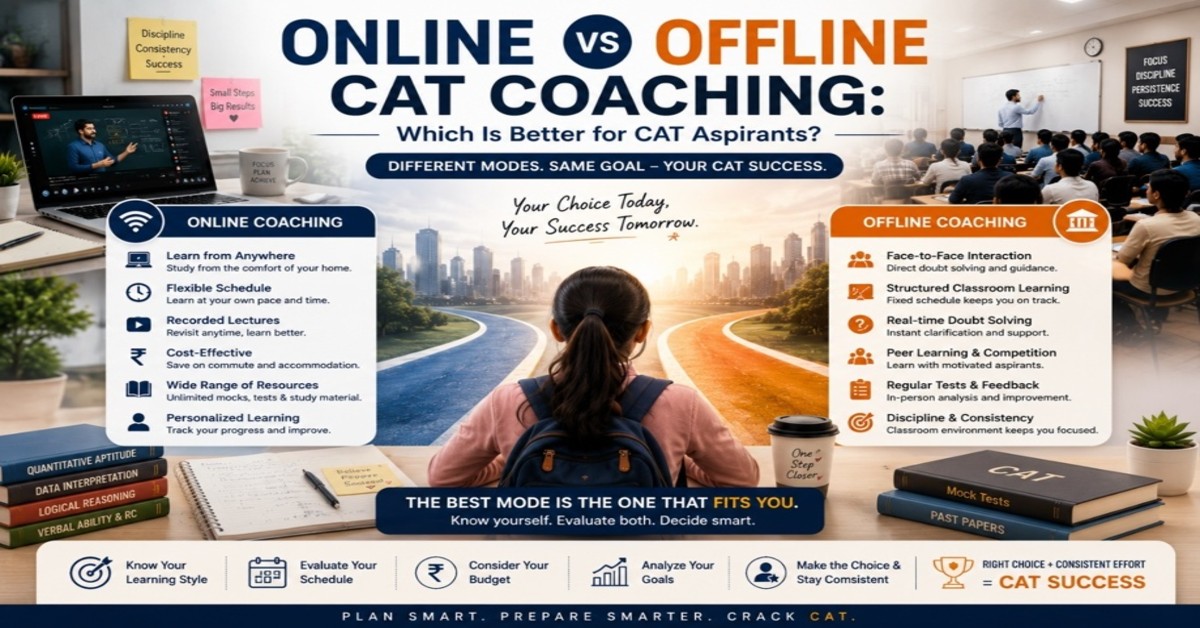
Online CAT coaching is defined as preparation provided through live virtual classrooms, pre-recorded video lectures, mobile apps, and digital mock-test platforms. Students can attend from anywhere without having to drive to a real location.
Offline CAT coaching, on the other hand, follows the traditional classroom methodology. Students attend fixed-time, in-person classes at a physical location, interact with teachers in person, take proctored mock exams in a computer lab, and study with a visible peer group.
Both approaches teach the same three CAT portions — VARC, DILR, and QA — and students who achieve 99+ percentiles use them. The difference is nearly completely in how the preparation is presented, rather than what is taught.
Cost comparison
Cost is frequently the first consideration for Indian hopefuls, and there is a big difference between the two types. Comprehensive online CAT programmes, which include live sessions, recorded content, mock exams, and study materials, are typically priced between Rs. 8,000 and Rs. 25,000 for the whole preparation cycle. Offline classroom programs at established institutes, in contrast, often vary from Rs. 40,000 to more than Rs. 1,20,000, depending on the city and brand.
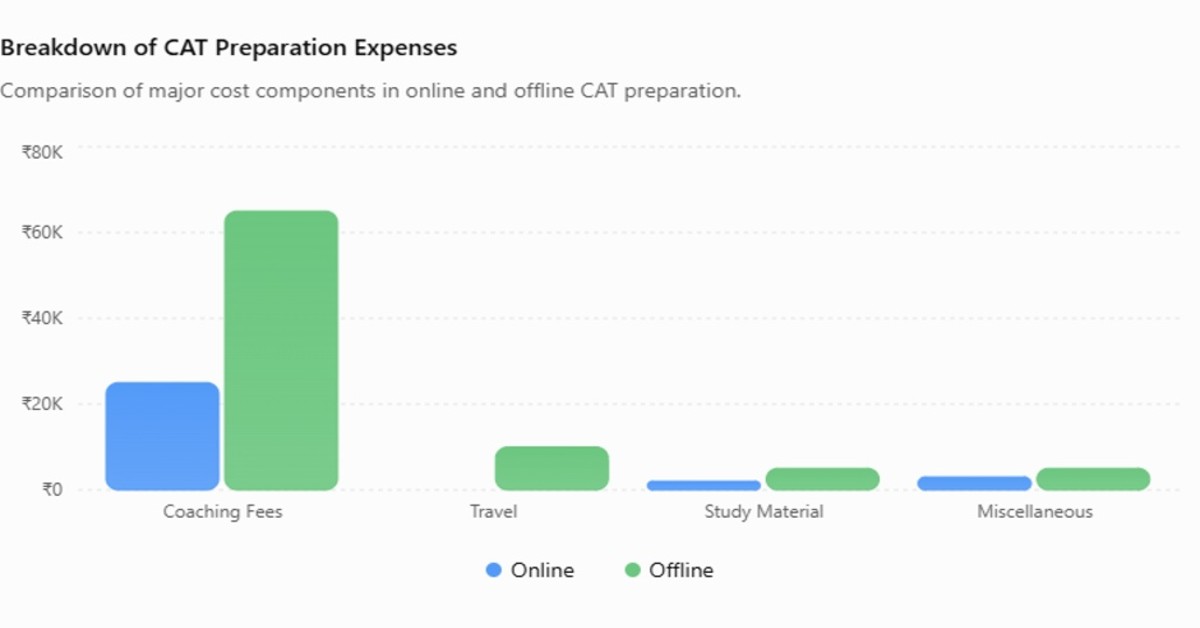
One of the most convincing reasons in favour of online CAT tutoring is the huge cost savings. Online CAT coaching normally costs ₹15,000-35,000, while offline classroom programs vary from ₹45,000-₹90,000. However, some online platforms often combine the increased price of offline coaching with extras that they charge separately, such as printed study material, in-centre proctored mocks, and dedicated GD-PI (Group Discussion-Personal Interview) instruction for the post-CAT admission rounds.
Time, Commute & Flexibility
For many Indian aspirants — especially working professionals and students in tier-2 and tier-3 cities — time is a scarcer resource than money.
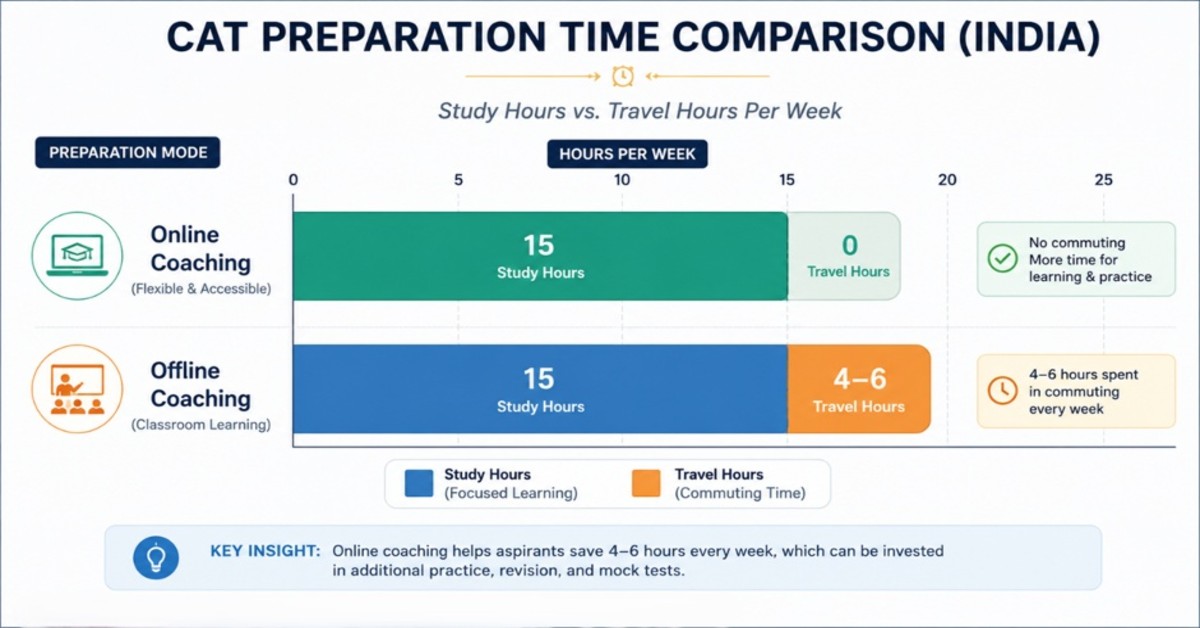
A typical offline coaching student in a metropolitan city commute to and from the centre for over two hours per day, totalling approximately 10-14 hours per week spent in transit. Over a six- to twelve-month preparation cycle, that equates to hundreds of hours that could otherwise be spent solving DILR sets or examining mocks.
Online coaching eliminates this completely. Classes can be taken from home, recorded lectures can be replayed at 1.5x speed while riding public transportation, and there is no need to migrate to a city with a strong offline centre.
Teaching quality & faculty access
This is the part that gets more attention for comparison, as:-
Online platforms can bring together instructors from across India on the same platform, allowing a student in Patna to learn DILR from a Delhi-based 99-percentiler without either of them leaving their city. This significantly expands access to expert training; coaching aggregator reviews highlight that institutes are increasingly competing for individual section specialists.
In contrast, offline coaching provides something that is very difficult to reproduce on a screen: real-time, face-to-face doubt resolution. When a student gets stuck in the middle of a question in class, the faculty member can see the confusion on their face and address it right away – no typing out the problem or waiting for a response in a doubt-solving group. For Quant and DILR especially, where a single conceptual gap can block an entire topic, this immediacy can meaningfully speed up learning.
Mock Tests, Doubt-Solving & Performance Tracking
Mock tests are essential—most serious aspirants practice between 30 and 50 full-length mocks before exam day, regardless of which teaching style they choose.
This significantly expands access to expert training; coaching aggregator reviews highlight that institutes are increasingly competing for individual section specialists — for example, dedicated DILR-focused professors rather than generalist batches.
Online platforms typically lead on the analytics side of simulated testing. Dashboards often break down performance by topic, question type, and time spent on each question, allowing students to pinpoint exactly where marks are being lost. Doubts are usually resolved using specific Telegram channels or in-app query mechanisms, with most platforms aiming for a few hours turnaround. Offline institutes respond with proctored, in-person mock tests that closely mimic real exam-day conditions — the same monitored, time-pressured, no-pause environment as the actual CAT — as well as immediate in-person mock analysis sessions in which a mentor walks through mistakes face-to-face.
Popular Online & Offline CAT Coaching Institutes in India
| Coaching’s | Popular Institutes in India |
| Online | iQuanta, Cracku, 2IIM, Rodha |
| Offline | TIME, IMS, Career Launcher, Bulls Eye |
| Hybrid | CATKing, MBAGuru, Quantifiers CAT Academy, Endeavor Careers |
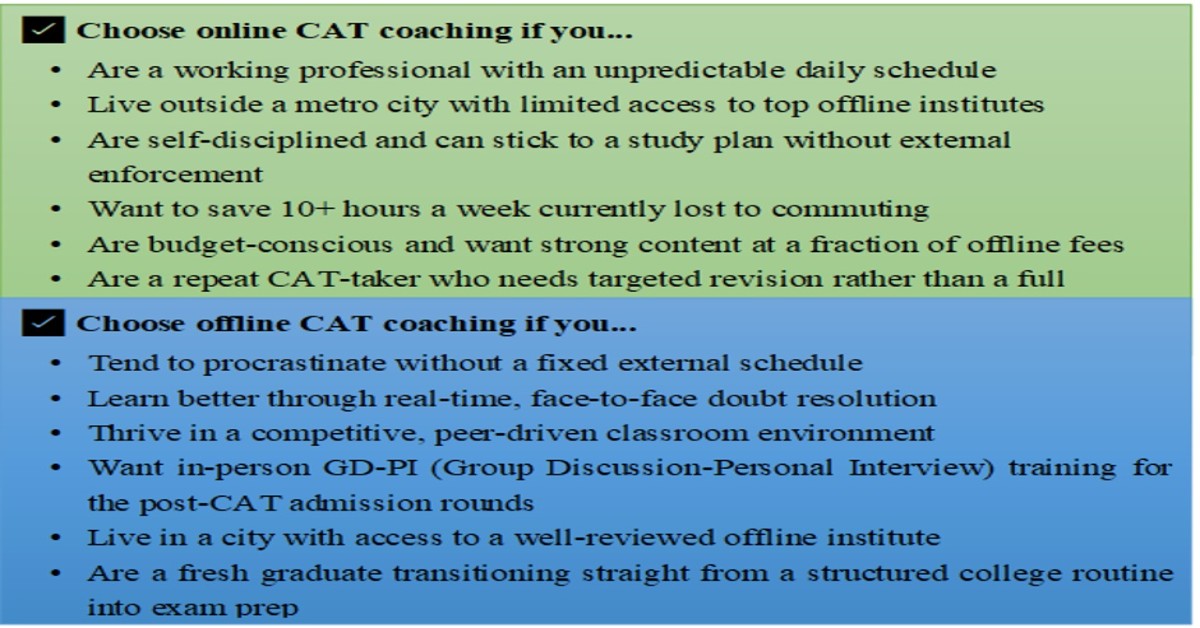
What should you choose?
Conclusion
The comparison between online and offline CAT coaching isn’t actually about which format teaches the syllabus better, as both cover the same VARC, DILR, and QA topics with instructors who are similarly qualified. It all comes down to which framework motivates you to invest in the 300–600 hours of concentrated, regular practice that are truly necessary for CAT achievement.
For Indian CAT candidates, online coaching has developed into a genuinely powerful option that is more affordable, quicker to access, and richer in analytics-driven feedback. Offline coaching has also maintained its importance: the discipline, immediacy, and peer competitiveness of a physical classroom are difficult to imitate on a screen. Most modern CAT applicants, particularly working professionals and students in smaller cities, find that online coaching provides a strong value proposition. However, children who require structured direction and accountability might learn the most from the offline coaching.
Ultimately, your consistency, mock test performance, and revision plan will have a far greater impact on your CAT percentile than the style of coaching you chose.
Frequently Asked Questions (FAQs)
1. Is online CAT coaching as effective as offline coaching?
Yes, online CAT coaching can be just as effective, provided the programme includes structured live classes, regular mock tests, fast doubt resolution, and performance analytics. Effectiveness depends more on the student’s consistency and the quality of the curriculum than on the delivery format itself.
2. Which is cheaper – online or offline CAT coaching?
Online CAT coaching is significantly cheaper in most cases, typically ranging from about Rs. 8,000 to Rs. 25,000 for a full programme, compared to Rs. 40,000 to over Rs. 1,20,000 for offline classroom coaching at established institutes in major cities.
3. How much time can I save by choosing online CAT coaching over offline?
Students who switch from offline to online coaching commonly save around 10 to 14 hours per week that would otherwise go into daily commuting to and from a physical coaching centre.
4. Is offline coaching better for students who lack self-discipline?
Generally, yes. Offline coaching enforces a fixed class schedule and places students in a visible peer group, both of which create external accountability. This structure tends to benefit students who find it difficult to stick to a self-paced study plan on their own.
5. Do top IIM-admitted students prefer online or offline coaching?
Both formats have produced 99-plus percentile scorers and IIM admits. Several well-regarded online platforms report a high share of top percentile scores among their students, while offline institutes with decades of legacy presence also continue to produce strong results. The format matters less than how consistently a student uses it.
6. Can I switch from offline to online CAT coaching mid-preparation?
Yes, many students do switch formats mid-year, especially if they feel an offline batch’s pace doesn’t match their level or if commuting is consuming too much study time. Most online platforms offer flexible enrolment, making a mid-cycle switch relatively straightforward.
7. What is hybrid CAT coaching, and is it worth it?
Hybrid coaching combines online classes for day-to-day learning with periodic offline elements, such as in-centre proctored mock tests or occasional mentoring sessions. It’s worth considering for students who want online flexibility but still feel they need some in-person checkpoint for accountability.
8. Does offline coaching provide better mock test conditions?
Offline coaching offers realistic CAT exam-like mock conditions and supervision, while online mock tests provide convenience and detailed analytics.
9. Is online coaching suitable for first-time CAT aspirants with no prior exposure to the exam?
Yes, online coaching is suitable for first-time aspirants as long as the programme starts from foundational concepts and includes a structured study plan. First-time aspirants who are naturally self-disciplined often do very well with online coaching; those who are unsure of their discipline level may benefit from starting with a hybrid or offline option instead.
10. How many mock tests should I take regardless of coaching format?
Most successful CAT aspirants attempt between 30 and 50 full-length mock tests before the exam, regardless of whether their primary coaching is online or offline. This number matters more for the final percentile than the coaching format chosen.
11. Which coaching format offers better GD-PI (interview) preparation after the CAT result?
Offline institutes generally have an edge in GD-PI preparation, as in-person group discussions and mock interviews are easier to simulate realistically in a physical setting. However, many hybrid and online platforms have also begun offering live virtual GD-PI sessions to close this gap.
You may also visit: CATMOCK INDIA|CATMOCK