

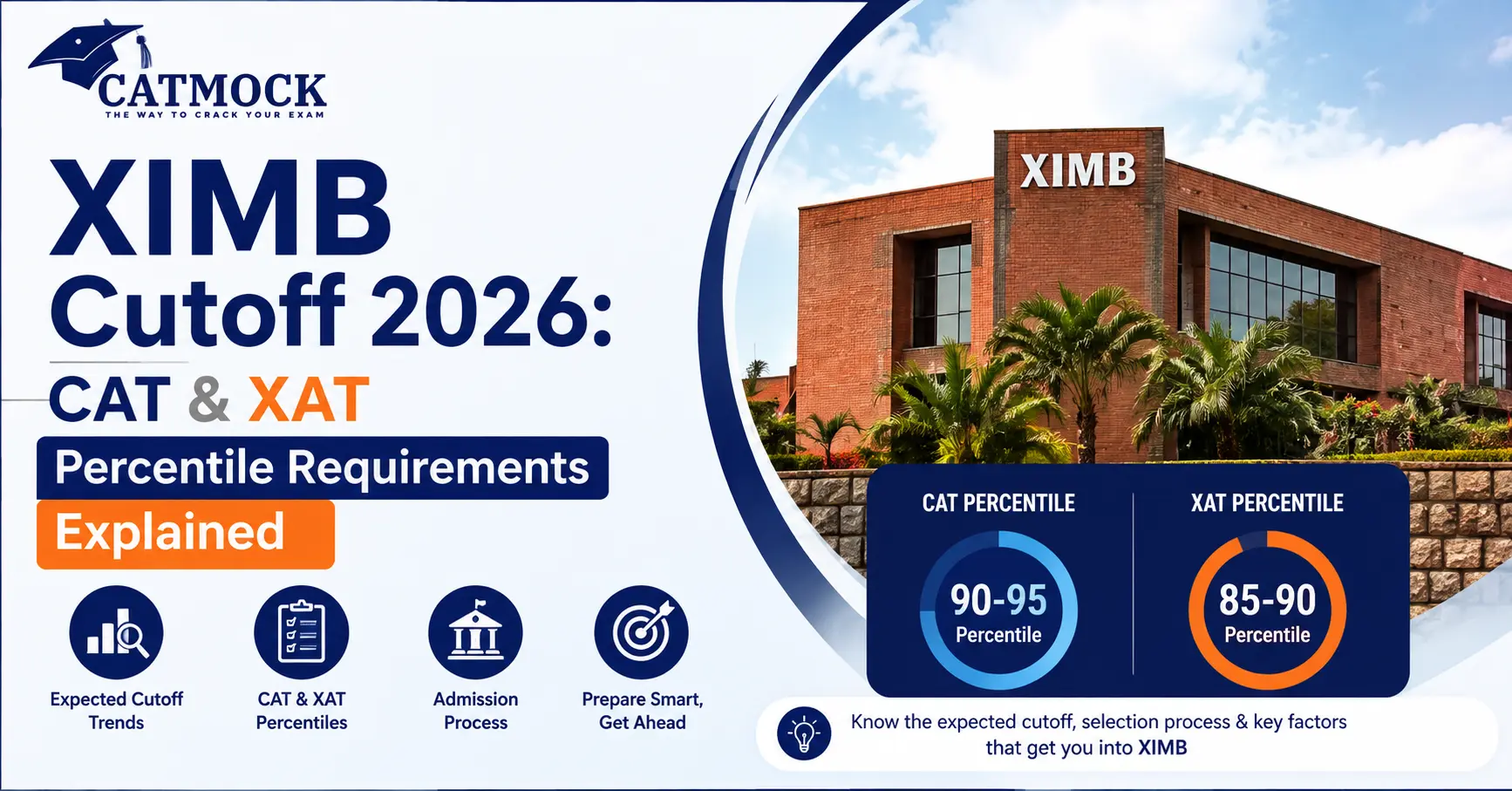
If you’re researching the XIMB cutoff, the first thing worth knowing is something most articles skip: XIM University does not publish a fixed, advance cutoff percentile for its flagship MBA-BM programme. Per the university’s own admission page, XIM University decides the section-wise and total cut-off marks used for shortlisting only after each year’s applicant pool is in — it isn’t a number fixed ahead of time that you can simply “clear.” Interview shortlist results are announced through the university’s own login-based results portal, not as an open percentile table on the website.
That doesn’t mean the number is a mystery, though. Based on how past cycles have played out — tracked by admission-guidance platforms and reported after each year’s shortlist is released — a fairly consistent range has emerged. This guide lays out that range clearly, distinguishes it from what XIM University actually confirms officially, and explains exactly how the process works so you’re not left guessing.
Quick Summary: XIMB Cutoff 2026 at a Glance
| Aspect | Detail |
|---|---|
| Exams accepted (MBA-BM) | XAT, CAT, GMAT, or XGMT (XIM’s own test) |
| Official cutoff published in advance? | No — decided internally each year, results shared via login portal |
| Reported CAT cutoff (general, non-domicile) | Roughly 89–92 percentile in recent cycles |
| Reported XAT cutoff (general) | Roughly 87–91 percentile in recent cycles |
| Sectional cutoffs applicable? | Yes, for both CAT and XAT — exact figures not officially disclosed |
| Category-wise reservation | XIMB is a private institution; no government-mandated reservation policy — domicile and gender-based variation is reported anecdotally by admission portals, not officially tabulated |
| Selection process | Cutoff → shortlist → Writing Ability Test (WAT), Group Discussion/Personal Interview → composite merit list |
Keep this table as an orientation point — the sections below unpack each row with the reasoning and sourcing behind it.
Which Entrance Exams Does XIMB Actually Accept?
This is where a lot of confusion starts, because “XIMB accepts CAT, XAT, GMAT, and NMAT” gets repeated as a blanket statement across the web — and it’s only partly accurate.
For the flagship two-year MBA-Business Management (MBA-BM) programme, XIM University’s own admission page confirms candidates need a valid score from XAT (conducted by XLRI), CAT, GMAT, or XGMT — the university’s in-house test. NMAT is not listed as an accepted exam for MBA-BM on the official page.
NMAT by GMAC, however, is accepted for a separate set of specialised MBA programmes at XIM University — MBA-HRM, MBA-RM (Rural Management), MBA-SM (Sustainability Management), MBA-UMG (Urban Management & Governance), and MBA-PPM (Public Policy & Management) — according to admission guidance coverage of these programmes. If you’re targeting one of these specialisations rather than the flagship MBA-BM, the accepted exam list and cutoff behaviour can differ, so don’t assume the MBA-BM cutoff automatically applies to your specific programme.
This distinction matters because most “XIMB cutoff” searches are really about the flagship MBA-BM programme (the one most people mean when they say “XIMB”), so that’s the focus of this guide — with specific notes where other programmes diverge.
How XIMB’s Selection Process Actually Works
Understanding the mechanics makes the cutoff numbers much easier to interpret. Per XIM University’s official process:
- You register for your chosen entrance exam (XAT, CAT, or GMAT) separately through that exam’s own conducting body, or appear for XGMT directly through XIM University.
- You also apply separately to XIM University through its own online application portal — registering for XAT/CAT/GMAT alone does not automatically apply you to XIMB.
- The Institute internally decides section-wise and total cut-off marks each year, based on that year’s applicant pool and score distribution, and uses this to shortlist candidates.
- Shortlisted candidates are called for Writing Ability Test (WAT), Group Discussion, and Personal Interview (WAT-GD-PI), typically held across multiple Indian cities.
- Final selection combines your entrance score with WAT-GD-PI performance, academic record, and work experience — not the entrance score alone.
This sequence is why “XIMB cutoff” and “XIMB admission” are two different milestones. Clearing the cutoff earns you an interview call. It does not, by itself, secure a seat.
XIMB CAT Cutoff: Reported Trends (Not Officially Published)
XIM University does not release a percentile-format CAT cutoff table publicly. The figures below are compiled from how education portals have tracked and reported XIMB’s shortlisting outcomes across recent admission cycles — treat them as directional, not guaranteed.
| Admission Cycle | Reported CAT Cutoff (General, Overall) | Source Type |
|---|---|---|
| 2026-28 batch | Around 89–92 percentile (non-domicile) | Reported by admission portals post-shortlist |
| 2024-26 batch | Around 91 percentile | Reported by admission portals post-shortlist |
| Typical recent range | 89–93 percentile | Aggregated estimate across multiple sources |
Multiple portals also note that XIMB applies a sectional CAT cutoff in addition to the overall figure — meaning a strong overall percentile with one very weak section (VARC, DILR, or QA) can still fall short at the shortlisting stage. Exact sectional thresholds aren’t officially disclosed, so the safest practice is aiming for reasonably balanced section-wise performance rather than relying on one strong section to carry your average.
If you’re still building your CAT prep strategy around a target percentile, it helps to see how XIMB’s expected range compares with other CAT-accepting institutes — CatMock’s CAT Cutoff 2026 guide breaks down college-wise and category-wise expectations across the wider CAT ecosystem.
XIMB XAT Cutoff: Reported Trends (Not Officially Published)
XAT is historically XIMB’s primary and largest-intake admission route, since XIM University is a member of the Xavier Association of Management Institutes (XAMI) that conducts and uses XAT scores. As with CAT, there’s no officially published percentile cutoff — the figures below reflect what admission-tracking portals have reported after past shortlists.
| Admission Cycle | Reported XAT Cutoff (General, Overall) | Source Type |
|---|---|---|
| 2026-28 batch | Around 87–91 percentile | Reported by admission portals post-shortlist |
| 2024-26 batch | Around 88 percentile | Reported by admission portals post-shortlist |
| Typical recent range | 87–93 percentile | Aggregated estimate across multiple sources |
XAT’s structure adds a wrinkle CAT doesn’t have: a Decision Making section and a General Knowledge score that XLRI-affiliated institutes sometimes weigh separately in final selection, even though GK doesn’t count toward your overall XAT percentile. If XAT is your primary route into XIMB, it’s worth building a dedicated strategy for the Decision Making section rather than treating XAT prep as a copy of your CAT preparation — CatMock’s XAT preparation guide covers this distinction in more depth.
Does XIMB Have Sectional Cutoffs?
Yes — for both CAT and XAT, XIMB is reported to apply minimum sectional thresholds alongside the overall percentile requirement, consistent with how most Xavier-affiliated and comparable B-schools shortlist candidates. The exact percentage isn’t officially published, so rather than chasing a specific unverified number, the more reliable approach is:
- Treat every section as independently important, not just your strongest one.
- Avoid leaving any section drastically under-attempted, even if you’re confident about your overall score.
- Review your section-wise mock performance regularly rather than only tracking your composite percentile.
What About Category-Wise and Domicile-Based Cutoffs?
This is an area where you should be genuinely cautious about what you read online. XIM University (which runs XIMB) is a private institution, and — unlike government-run or government-aided institutes — it does not operate under a statutory reservation policy for SC/ST/OBC categories. Several admission-guidance sources explicitly confirm there’s no formal government-mandated reservation framework at play here.
At the same time, a number of portals report that XIMB’s cutoff and seat allocation vary informally by domicile status (Odisha-domicile candidates versus non-domicile) and, in some cases, by academic background (engineering versus non-engineering) or gender, as part of the institute’s own diversity and composite-profile considerations. These variations aren’t published as an official percentile table, and different portals report somewhat different figures for them.
Given this lack of a single verifiable official source, this guide deliberately does not present a category-wise cutoff table with specific numbers — doing so would risk passing off unconfirmed figures as fact. If domicile or category-based admission policy specifically affects your application, the most reliable step is to confirm directly with XIM University’s admission office using the contact details on its official MBA-BM admission page.
XIMB Cutoff vs Final Admission: What’s the Difference?
It’s worth being precise about this distinction, since it shapes how you should interpret every number in this guide:
- Cutoff — the internally-set minimum score (overall and sectional) that gets your application into the shortlisted pool for WAT-GD-PI.
- Shortlisting — being invited to appear for the Writing Ability Test, Group Discussion, and Personal Interview rounds, held across multiple cities.
- Final Admission — a composite decision combining your entrance exam score, WAT-GD-PI performance, past academic record, and relevant work experience, as officially confirmed by XIM University.
Clearing even a comfortably high CAT or XAT percentile does not guarantee a seat at XIMB. Plenty of candidates who clear the cutoff do not make it through the interview stage, and the university is explicit that final selection factors in more than the entrance score alone.
What To Do After You Meet (or Think You’ve Met) the Cutoff
- Don’t wait for a public cutoff announcement to prepare for the next stage. Since XIMB confirms shortlists through its own login portal rather than a public notice, keep checking your application status directly and start WAT-GD-PI preparation as soon as results are declared for your exam.
- Revisit your sectional performance, not just your overall percentile, since a lopsided score can quietly disqualify an otherwise strong application.
- Prepare a clear, honest academic and career narrative for the Personal Interview — XIMB’s process weighs your profile and work experience alongside the interview itself.
- Practice structured Writing Ability Test responses under time pressure, since WAT performance is scored as part of the composite process, not treated as a formality.
- If your score fell short this cycle, consider whether a CAT or XAT retake for the next admission cycle is realistic — reviewing previous-year CAT question papers or working through a structured CAT mock test series is a practical way to close specific sectional gaps before your next attempt.
Frequently Asked Questions
Does XIMB officially publish its CAT and XAT cutoff percentile?
No. XIM University decides section-wise and total cutoff marks internally each year based on the applicant pool, and shares shortlist results through its own login-based results portal rather than publishing an open cutoff table.
What CAT percentile is generally needed for XIMB?
Based on how recent admission cycles have been reported by education portals, general-category candidates have typically needed a CAT percentile in the high 80s to low 90s, though this is not an officially confirmed figure and varies year to year.
What XAT percentile is generally needed for XIMB?
Reported figures from recent cycles suggest a range roughly between 87 and 91 percentile for general-category candidates, though — again — this isn’t officially published by XIM University.
Does XIMB accept NMAT scores?
Not for the flagship MBA-BM programme, based on XIM University’s official admission page, which lists only XAT, CAT, GMAT, and XGMT as accepted tests for MBA-BM. NMAT is reported to be accepted for certain other specialised programmes such as MBA-HRM and MBA-RM.
Does clearing the XIMB cutoff guarantee admission?
No. Clearing the cutoff only shortlists you for the Writing Ability Test, Group Discussion, and Personal Interview rounds. Final admission is a composite decision that also weighs your interview performance, academic record, and work experience.
Are there separate cutoffs for reserved categories at XIMB?
XIM University is a private institution without a statutory government reservation policy. Some domicile or diversity-based variation in cutoffs is reported anecdotally by admission-guidance portals, but there is no single official, verifiable category-wise cutoff table available publicly.
Conclusion
The most important thing to take away about the XIMB cutoff is that it isn’t a single fixed number XIM University announces in advance — it’s set internally each year and only becomes visible once shortlists are released through the university’s own portal. The 87–93 percentile range reported across recent CAT and XAT cycles is a genuinely useful planning benchmark, but it should guide your preparation targets, not your certainty about admission. Focus on clearing both the overall and sectional requirements comfortably, treat the WAT-GD-PI stage as equally important as the entrance exam itself, and confirm anything programme-specific — especially around accepted exams or domicile-based variation — directly with XIM University’s admission office before finalising your application strategy.
You May Also Like : CATMOCK / CATMOCK PYQ
Follow Us On : Facebook / Instagram