

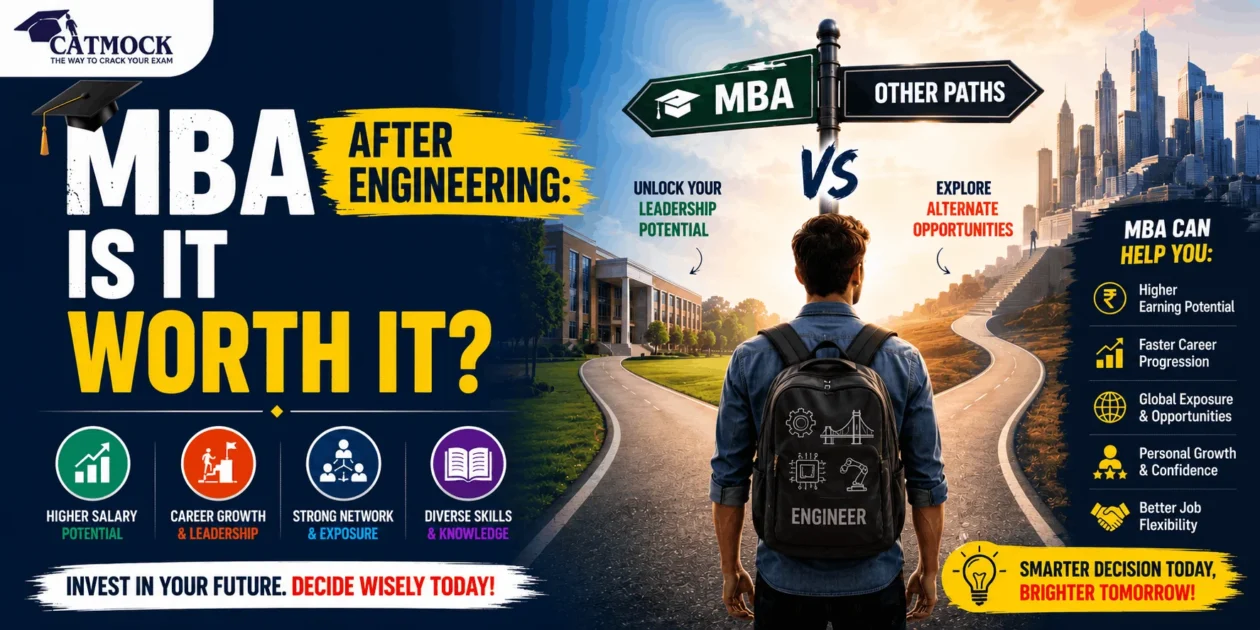
You’ve spent four years mastering circuits, code, or structural loads. Now you’re staring at a CAT or GMAT syllabus wondering if switching lanes into management actually pays off — or if it’s just expensive peer pressure.
Short answer: it depends on what you’re optimizing for. Long answer: keep reading, because the decision hinges on numbers most articles gloss over — actual ROI timelines, specialization-wise salary shifts, and which engineers benefit most.
Why So Many Engineers Consider an MBA
Engineering builds technical depth, but most engineering roles have a visible career ceiling around the mid-level unless you move into people management, product strategy, or business leadership. An MBA is often the fastest structured route to that transition.
Three patterns show up repeatedly among engineers who pursue an MBA:
- The Techie-to-Manager shift — engineers who’ve spent 2-5 years coding or designing and now want to lead teams instead of building the product line-by-line.
- The Domain-Switcher — engineers moving from core engineering (mechanical, civil, electrical) into consulting, finance, or product management, where an engineering-only resume doesn’t open doors.
- The Entrepreneur-in-Training — engineers who want to eventually start their own venture and need exposure to finance, marketing, and operations that a technical degree simply doesn’t cover.
If you don’t see yourself in any of these three, an MBA might not be the right next step — and that’s worth knowing before you spend two years and a significant sum finding out.
Not sure if the switch is right for you? Read our MBA vs. Job comparison
The Real Cost of an MBA After Engineering
This is where most articles get vague. Here’s a realistic cost comparison across program types in India (figures are indicative averages and vary by institute and year — always verify current fees directly with the college):
| MBA Program Type | Duration | Approx. Total Cost (INR) | Typical Candidate Profile |
|---|---|---|---|
| Top-Tier IIM (A/B/C) | 2 years | ₹21–26 lakhs | 0–3 yrs experience, high CAT percentile |
| Tier-2 IIMs / Top Private (ISB, XLRI, etc.) | 1–2 years | ₹15–35 lakhs | 2–8 yrs experience |
| Mid-Tier B-Schools (NMIMS, SPJIMR, etc.) | 2 years | ₹8–16 lakhs | 0–5 yrs experience |
| Executive MBA / One-Year Program | 1 year | ₹18–30 lakhs | 5+ yrs experience |
| Distance/Online MBA (UGC-recognized) | 2 years | ₹1–4 lakhs | Working professionals, budget-conscious |
Beyond tuition, factor in the opportunity cost — two years of forgone engineering salary, which for a mid-level engineer in India can easily add ₹10–18 lakhs to the true cost of a full-time MBA. If you’re planning to fund this through an education loan, it’s worth understanding the eligibility and interest-rate structure before you apply.
Education Loan for MBA: Process, Eligibility & Interest Rates
UGC guidelines on recognized distance and online MBA programs
Does an MBA Actually Increase Your Salary? A Data-Backed Look
This is the question that matters most, and the answer is: it depends heavily on which MBA and which specialization.
| Post-MBA Role | Avg. Pre-MBA Engineer Salary (INR/yr) | Avg. Post-MBA Salary (INR/yr) | Approx. Salary Jump |
|---|---|---|---|
| Product Manager | 8–12 lakhs | 18–30 lakhs | 100–150% |
| Management Consultant | 7–10 lakhs | 20–35 lakhs | 150–200% |
| Investment Banking / Finance | 6–9 lakhs | 18–28 lakhs | 120–180% |
| Operations/General Management | 8–11 lakhs | 15–22 lakhs | 60–100% |
| Core Engineering (no switch) | 8–12 lakhs | 10–14 lakhs | 15–25% |
The pattern is clear: an MBA delivers the strongest ROI when paired with a functional switch — into consulting, product, or finance — rather than staying in the same core engineering track. If your goal is to remain a hands-on engineer, an MBA offers a much smaller salary bump relative to its cost.
Bureau of Labor Statistics — Management Occupations wage data for a global salary-trend comparison
Alternatives to an MBA Worth Considering First
Before committing, it’s worth weighing options that solve the same underlying goal — career growth — at a fraction of the cost or time.
| Alternative Path | Cost | Time | Best For |
|---|---|---|---|
| M.Tech / M.S. (Technical Deepening) | ₹1–8 lakhs | 2 years | Engineers who want to stay technical and go deeper (R&D, specialized roles) |
| Product Management Certification | ₹30k–2 lakhs | 3–6 months | Engineers targeting PM roles without a full MBA |
| Data Science / Analytics Certification | ₹50k–2 lakhs | 6–12 months | Engineers pivoting into analytics-heavy roles |
| Internal Promotion + On-the-Job Leadership | Minimal | Ongoing | Engineers already in high-growth companies with visible leadership tracks |
| Full-Time MBA | ₹8–35 lakhs | 1–2 years | Engineers seeking a functional switch (consulting, finance, GM roles) |
If your target role genuinely requires the network, brand, and generalist business exposure an MBA provides, none of the alternatives substitute for it. But if you only need a specific skill set, a certification often gets you there faster and cheaper.
Who Should (and Shouldn’t) Do an MBA After Engineering
You’re a strong candidate if:
- You want to move into consulting, product management, general management, or finance.
- You’ve identified a skill gap (strategy, finance, marketing) that’s genuinely blocking your next role.
- You have at least 1–3 years of work experience, which top B-schools weigh heavily in admissions and which sharpens how you apply classroom learning.
- You’re prepared for the CAT, GMAT, or GRE and can realistically target a college whose average placement outcomes justify the fee.
You should reconsider if:
- You’re doing it mainly because peers are doing it, or out of uncertainty about your career rather than a clear goal.
- You want to remain deeply technical — an M.Tech, a specialization certification, or staying in your current track with visible skill-building may serve you better.
- You can’t get into a college with strong placement records; a low-ranked MBA rarely delivers the salary jump needed to justify the cost and time.
Best MBA Specializations for Engineers
Not all specializations suit an engineering background equally. Here’s how the common options map to technical backgrounds:
| Specialization | Why It Fits Engineers | Typical Post-MBA Roles |
|---|---|---|
| Operations Management | Builds directly on process, systems, and efficiency thinking from engineering | Operations Manager, Supply Chain Lead |
| Product Management | Combines technical fluency with business strategy — a natural fit for CS/IT engineers | Product Manager, Product Owner |
| Finance | Quant-heavy coursework suits engineers comfortable with numbers and modeling | Investment Banking Analyst, Corporate Finance |
| Marketing | Less intuitive for engineers but valuable for those targeting FMCG, tech marketing | Brand Manager, Growth Marketing Lead |
| Strategy/Consulting | Broad generalist path; rewards strong problem-solving and structured thinking | Management Consultant, Strategy Associate |
Engineers with a computer science or IT background typically gravitate toward Product Management and Consulting, since both value technical credibility combined with business judgment. Core-branch engineers (mechanical, civil, electrical) often find Operations and Supply Chain roles a more natural extension of their existing expertise.
Timing: When Is the Right Time to Do an MBA After Engineering?
Timing affects both admission chances and the eventual ROI more than most candidates realize.
- 0–1 years of experience: You can apply, but most top B-schools weight this profile lower than experienced candidates. Some schools run dedicated “early career” or “young graduate” tracks — worth checking before ruling this out.
- 2–4 years of experience: Widely considered the ideal window. You have enough real workplace context to contribute meaningfully in case studies and group discussions, and recruiters view this experience band favorably during placements.
- 5+ years of experience: A regular two-year full-time MBA becomes less common at this stage; an Executive MBA or a one-year program (like ISB’s PGP) is usually a better structural fit, both academically and in terms of peer group.
Waiting too long, however, has a cost too — the further you are from a technical role, the harder it can be to pivot back if the MBA doesn’t lead where you expected. There’s no universally “perfect” year, but the 2–4 year window offers the best balance of admission competitiveness and career flexibility.
If you’re past the 5-year mark, it’s worth comparing structural formats before you commit to one.
Executive MBA vs Regular MBA: Which One Should You Choose in 2026?
A Simple ROI Framework You Can Run Yourself
Rather than relying on generic averages, run this quick calculation for your specific target program:
- Total Cost = Tuition + Living Expenses + (Current Annual Salary × Program Duration in years)
- Expected Gain = (Realistic Post-MBA Salary − Current Salary) × Number of Years You Plan to Stay in the New Field
- Break-Even Point = Total Cost ÷ (Expected Post-MBA Salary − Current Salary)
If your break-even point comes out under 3 years, the investment is generally considered strong. Anywhere between 3–5 years is moderate and worth weighing against alternatives. Beyond 5 years, it’s worth seriously reconsidering whether a certification or on-the-job path might serve you better. To plug in realistic numbers, it helps to know which companies are actually hiring and at what packages.
Top Recruiters at IIMs: Company & Campus Breakdown
How to Prepare If You Decide to Go for It
If the numbers and self-assessment point toward “yes,” preparation strategy matters as much as the decision itself.
Choosing Between CAT, GMAT, and GRE
- CAT is the standard route for IIMs and most top Indian B-schools; it’s rigorous on quant and logical reasoning, which often plays to an engineer’s natural strengths.
- GMAT opens doors to ISB, global MBA programs, and some private Indian institutes with rolling admissions.
- GRE is a viable alternative if you’re also considering international MS or MBA programs simultaneously.
Building a Study Timeline
Most working engineers need 6–9 months of consistent preparation, balancing a full-time job with study. A realistic weekly split: 2 hours on weekdays, 4–5 hours on weekends, with mock tests ramping up in the final 3 months.
Free full-length CAT mock tests
CAT and MBA entrance exam details, pattern, and eligibility
AICTE — the statutory body that approves and regulates management education programs in India
Picking the Right College
Don’t just chase brand name — check placement consistency over 3–5 years, not just one good year, and look at the median (not just average) salary, since averages can be skewed by a handful of outlier offers. It also helps to research specific colleges in depth rather than relying on brand reputation alone.
Want to see what deep-dive college research actually looks like? Here’s a full profile covering admissions, fees, and placements for one top B-school as an example — K J Somaiya Institute of Management: Complete Guide to Admissions, Fees & Placements
NIRF Management Rankings — Government of India
Key Takeaways
- An MBA after engineering delivers the highest ROI when it’s paired with a functional career switch — into consulting, product, or finance — not when you stay in the same technical track.
- College quality matters more than the degree itself. A low-ranked MBA rarely justifies its cost; a top-tier one can pay for itself within 2–3 years.
- Factor in opportunity cost, not just tuition — two years away from an engineering salary adds meaningfully to your true investment.
- Alternatives like M.Tech, PM certifications, or targeted upskilling can achieve similar goals faster and cheaper for specific career switches.
- Preparation (CAT/GMAT/GRE) typically needs 6–9 months of focused effort alongside a full-time job — start early and track progress with regular mock tests.
Frequently Asked Questions
Is it better to do an MBA right after engineering or after work experience?
Most top B-schools, especially IIMs, favor candidates with 1–3 years of work experience because it improves the classroom discussion quality and helps candidates apply concepts practically. Freshers can still get in through specific programs designed for them, but overall placement outcomes tend to be stronger for candidates with some prior work exposure.
Which engineering branch benefits most from an MBA?
There’s no single branch that benefits exclusively, but engineers from computer science, IT, and electronics often transition smoothly into product management and consulting roles, while mechanical, civil, and chemical engineers frequently use an MBA to move into operations, supply chain, or general management functions.
Can I do an MBA after engineering without a good CAT/GMAT score?
Yes, but your options narrow to mid-tier or lower-tier institutes, where the salary ROI is typically much lower. If your score isn’t competitive yet, it’s often worth taking an additional 6–12 months to prepare rather than settling for a program with weak placement outcomes.
Is an online or distance MBA after engineering worth it?
An online MBA from a UGC-recognized university can be worth it if your goal is skill-building or a formal credential while continuing to work, but it rarely delivers the same salary jump or network effect as a full-time program from a reputed college. It’s a reasonable choice for incremental growth, not for a major career pivot.
How much work experience is ideal before applying for an MBA after engineering?
For most full-time MBA programs, 2–4 years of work experience is considered the sweet spot — enough to have real management-relevant stories for your application and interviews, but not so much that you’re competing against candidates targeting executive-level programs instead.
Conclusion: Making the Decision With Data, Not Pressure
An MBA after engineering isn’t universally “worth it” or “not worth it” — it’s worth it for the right candidate, targeting the right role, at the right college. If you can clearly articulate the functional switch you want (consulting, product, finance, general management), and you’re willing to put in focused preparation for a top-tier program, the ROI numbers strongly favor making the move. If you’re chasing the degree without a clear “why,” it’s worth pausing and exploring lower-cost alternatives first.
Whichever direction you choose, start with an honest self-assessment, run the actual cost-versus-salary numbers for your target roles, and only then commit to a preparation timeline.
Start your CAT preparation with free mock tests
You May Also Like : CATMOCK / CATMOCK PYQ
Follow Us On : Facebook / Instagram